
How to find joy and satisfaction across your swimming
Swimming gives us plenty of long-term benefits: fitness, strength, mobility, resilience, and better physical and mental health. It is also common, particularly for certain personality types, to fixate on future swimming goals – an event or challenge perhaps.
There is nothing wrong with goals and ambitions. They motivate us and help us build structure around our swimming. But there is a danger that it turns the swimming you do into another task that needs to get done in your busy day. Workouts become, well, work.
And, of course, you need to put in the work to achieve your goals. But hard work doesn’t necessarily mean suffering. Swimming can give us very positive experiences in the moment, even during training. The trick is to notice and appreciate them.
Here are some experiences you could try building into or becoming more aware of in your swimming.
1. The joy of raw power and unbridled speed
An invitation to do sprints can send some swimmers into a panic. But it shouldn’t. Obviously, if you try to swim fast for a long distance or don’t take sufficient rest between fast efforts, it will hurt. Instead, try very short, maximum effort sprints – I’m talking about 25m sprints, or even 15m sprints. Then take as much rest as you need. This shouldn’t excessively spike your heart rate or make you out of breath, but will give a buzz that only all-out speed can. There is something uplifting about moving your body as fast as it will go and unleashing every bit of power you have. Try it.
2. The confidence and rhythm of easy speed
One step down from all-out sprinting is a special gear that some swimmers refer to as easy speed. It’s fast but controlled and sustainable for perhaps 50 to 75m – and it feels amazing, like you’re carving effortlessly through the water. For me, it’s the pace I try to lock into for the first part of a 200m race. It gets me off to a good start but holds enough back to finish the race strong. To access it in training, you need to warm up properly, allow yourself plenty of rest between swims and focus on feeling relaxed yet strong.
3. The empowering burn of a well-paced CSS set
Critical Swim Speed (CSS) is, loosely speaking, your speed for a maximum effort 1500m swim. If you do the full 1500m at that pace, it will hurt. But in training, we often break the distance into blocks of 100m and 200m, with rests of 10 to 20 seconds between. The short rests have a magical effect on your swimming and allow you to swim at that 1500m speed much more comfortably. If you pace these sets well, it can actually get easier as you work through the set. Your body loosens, your mind relaxes, you settle into a rhythm, and you feel a surge of energy flooding through you. For me, this works especially well if I’m swimming side by side with a training partner.
4. The meditative flow of a long-distance swim
To achieve this, I prefer a continuous open water swim – a stretch of river or the sea – but some people experience this on long swims in the pool too. These are the swims where you lose track of time and give in to the metronomic beat of your hands entering the water and the gentle rush of bubbles past your ears as you breathe out underwater. There is no struggle or effort. It’s just a state of being that only exists in the water. Calm, meditative, peaceful yet moving.
5. The inverse-baked Alaska of cool water
Swimmers often talk about the buzz and afterglow they get from cold water swimming, but they mention less often the electrifying sensation of being cold but not cold. Our skin reacts immediately to cold water immersion, sending us into the panicky discomfort of cold water shock. If we stay in too long, our core body temperature starts to fall, creating its own kind of discomfort and misery. But between the time of getting through cold water shock – typically 1 to 2 minutes – and the onset of hypothermia is a magic window. Like the witches in Northern Lights, you feel the cold on your skin, but it’s not harming you – at least, not immediately. Outside you’re cold, but inside you’re warm. Every part of your skin tingles. For me, the optimal temperature to achieve this is between 10 to 15 degrees – but you will find your own range.
Just be aware that even though you feel amazing, your body is cooling. It’s safest to get out while you still feel good.
6. The adrenaline rush of catching a ride on a wave
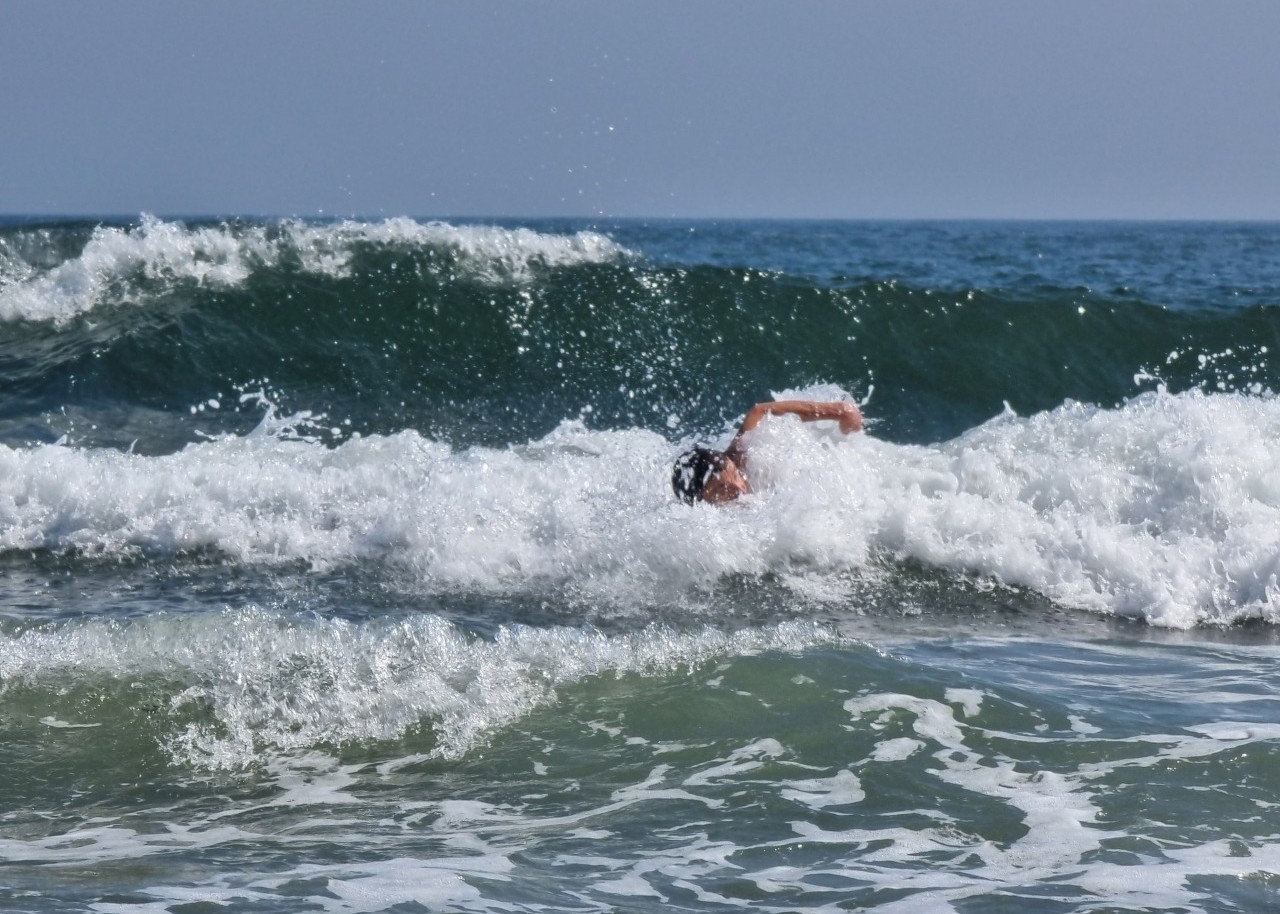
Body surfing involves a lot of waiting around and watching the waves rolling in. You’re looking for one of the right size (neither too big nor too small) that’s piling up but not yet breaking. As the perfect wave approaches, you swim away from it at maximum speed. It catches you, lifting your feet. Brace your core, lift your head and stretch one arm ahead, palm skimming the surface. If you’ve timed it right, the wave will accelerate you forward. You’ll carve a V through the water with your hand, the spray flying either side of your face. The water rushes under your chest, bumping and bubbling. This is the fastest you’ll ever move through water. You may whoop with delight. Eventually, the ride comes to an end as the wave crashes around you. Hold your breath, relax, and let the wave do what it will. I like to curl up as the wave breaks to protect my back.
I’m sure you have your own special moments in the water. These are just six that sprung to mind. I recommend approaching every swim with your mind open to the possibility of uncovering the joy in it. It’s the Renaissance Swimmer thing to do.
What special moments do you seek out in the water? Let me know.
