Short swims are not just for beginners, says Lucy Young
I’m writing this still buzzing from my recent swim at Brighton. It was another fun day out with my 16-year-old son Ed, who was doing his second-ever open water event (you can read how his first one made me feel here). The water was glorious, and I loved swimming under (and alongside) the pier in the 2.5K event.
When it was Ed’s turn to compete in the 750m, he bravely decided to do it without his wetsuit. With the confidence of youth, he declared he was, ‘in it to win it,’ he claimed a spot at the front on the start line, and set off at a punchy pace.
The excitement built as a lead pack separated from the rest of the field and I knew Ed was in there. As they raced towards the finish line, I could see him in the front row, checking his line to the finish and watching his competitors. It came down to a tight sprint finish with Ed clinching the win with a final burst of energy.
He was beaming on the day, and he wore his finisher’s medal with pride. I know he was delighted that he’d done it without the wetsuit. His connection with the water will have been enhanced, and he was pleased to have met the challenge of sighting in the waves, without the added buoyancy provided by a wetsuit.
More than a toe-dip
But I could tell something wasn’t quite right. Something was niggling him.
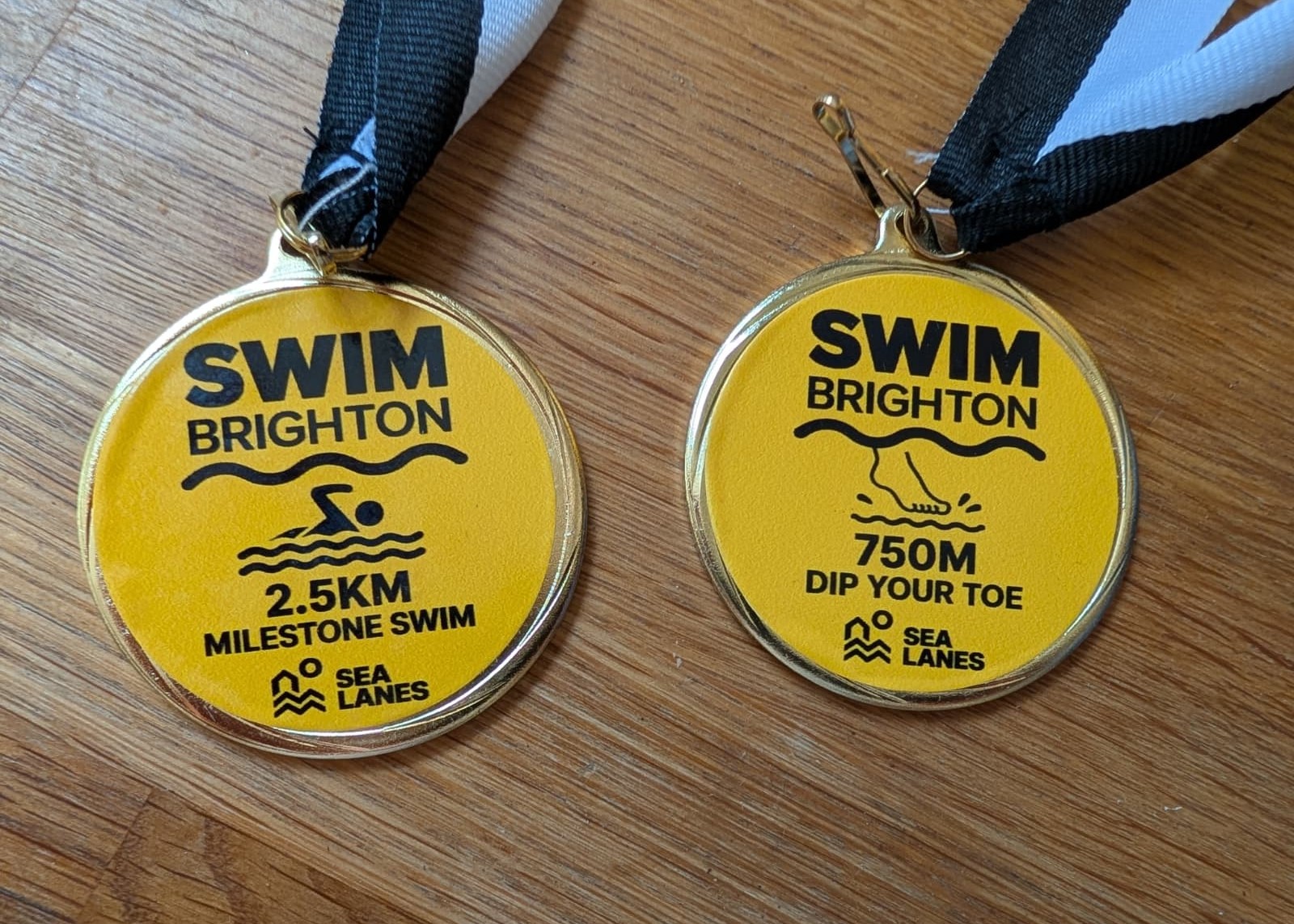
It turns out it was the medal. The 750m swim was described as a “Dip Your Toe” event, and this was repeated on the medal, which somehow belittled the challenge.
Now, I know that isn’t the organisers’ intention. They couldn’t be more supportive of newcomers to the sport. Nor could they be more skilled when it comes to safety support for swimmers of mixed speed and ability in the water.
But the sentiment expressed here, and mirrored elsewhere in open water, is that the 750m event isn’t really for serious or experienced swimmers.
In Brighton, the 750m distance is billed as the beginner’s option. It’s viewed as a stepping stone to their ‘milestone distance’ of 2.5K. To be honest, I find this is a pretty standard view in open water. It is mostly undisputed that longer distances are somehow more ‘worthy’ challenges, things you progress to once you’ve conquered shorter swims.
But that belief is surely open to question, and it certainly depends on your approach to the swim.
A short swim swum at speed, jostling in a pack, with close attention to pacing, sighting and the angle of approach to turn buoys requires strength, fitness and good open water skills. There is no margin for error in a sprint distance, as all mistakes are magnified and tricky to rectify. You have to nail it from the start if you want to emerge victorious at the front of a racing pack, and that is exactly what Ed did on Saturday, so I can see why he felt like the sentiment on the medal didn’t represent his experience in the water.
It’s different in the pool
It is interesting that in pool swimming, it’s often the sprinters who are celebrated. For example, Cameron McEvoy, who currently holds the 50m FC World Record with the bionic time of 20.88 seconds, focuses his entire training around this distance. He’s known for his methodical and scientific approach to training, seeking out every nuance that will help him cover a single length of the pool faster. He has famously reduced traditional training volumes in favour of highly specific, quality-driven sprint work.
He is clearly the man to watch and to emulate, and yet, he is travelling halfway around the world to unleash his power for less than 21 seconds in the pool. When he broke the existing record in March 2026, the swimming world went wild. No one said he should have swum a longer distance to be more worthy.
Rethink those shorter distances
So, perhaps we have to reshape how we view shorter distances in open water. The 750m event at Brighton was clearly a brave venture for many. For some, it was a first taste of the open water, for others, a first measured distance in the sea, pitted against waves, chop and current. For Ed, it was a hard-fought, tactical race. Some of the 750m swimmers may well ‘progress’ onto the 2.5K next year, confidence boosted, experience now in the bag, but they should not feel like they have to.
Even the most experienced open water veterans might actively choose to enter shorter distances simply for the tactical challenge and the fun of the sprint. When there are options, I sometimes choose the shorter distance for these reasons. Shorter swims can also be done fairly spontaneously, without long months of training.
It’s common to want to test how far you can swim, and to aim for ever longer distances, but it’s not the only way to measure improvement in your open water swimming. Shorter swims are challenging in a different way, and require a sharper focus on execution and open water skills.
Bear in mind that the longer-is-better mindset risks closing off possibilities and might steer you to view open water swimming as an exhausting test of endurance. It doesn’t always have to be like that for a swim to be fun, worthy and challenging. A short event can definitely be so much more than a ‘toe dip’, and it shouldn’t be downplayed as simply a stepping stone to something more.