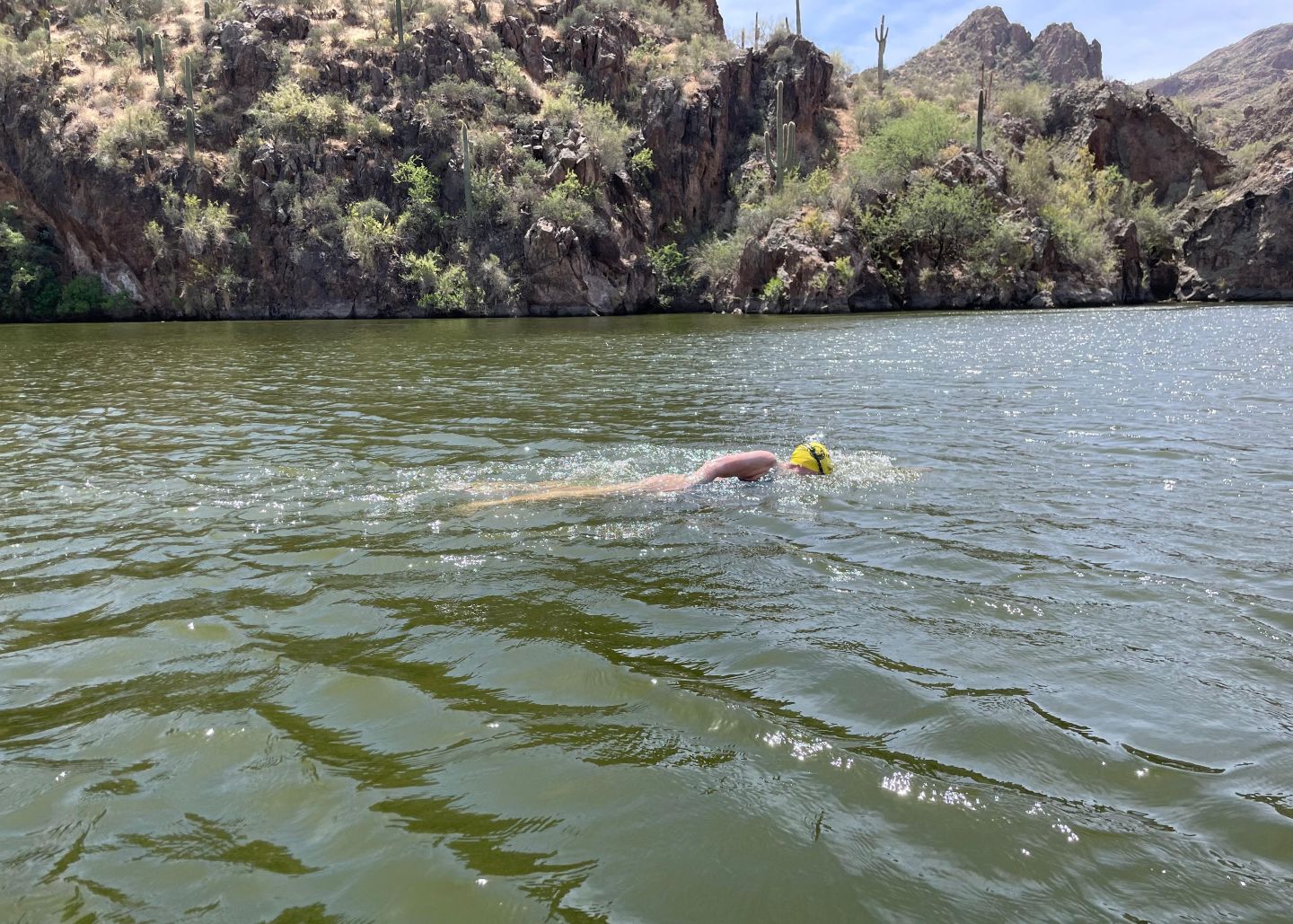
Marti Henshaw tackled the first swim of SCAR in a difficult year
SCAR is an annual open water swimming challenge through four lakes in Arizona. Renaissance Swimmer Club member Marti Henshaw decided to swim Lake Saguaro in 2026. It turned out she picked a difficult year!
According to SCAR founder and race director Kent Nicholas, “Saguaro was a beast this year and I expected to pull at least half the field because the countercurrent was difficult for swimmers to get by.”
This is Marti’s story.
Late in the fall of 2025, I decided that I needed a swimming goal. For me, this meant something open water. Not having big bucks, I couldn’t choose a foreign swim adventure, and so looked in my backyard instead.
The only open water event in Arizona is “SCAR”, a four-day 40-mile swim challenge through lakes Saguaro, Canyon, Apache and Roosevelt. While many swimmers take on all four swims, there is also the option to apply to do one, two or three.
I have a good handful of friends who have done some or all of SCAR, so I started asking which lake to swim. I first thought about the 10k in Roosevelt but decided that I didn’t want to swim at night. I also checked the Long Swims Database, which lists the true distances, and enquired about water temperatures.
As the shortest and warmest, Saguaro won (13.3km/8.26mi, 20-21°/70° water). I was still on the fence, but my friend, Marnie, said that if I got in, she would paddle for me. The gauntlet was thrown. On November 15th, I put in my application and waited. On the 2nd of January, I got the acceptance notice and paid my money.
The four lakes of SCAR are all reservoirs on the Salt River. These lakes are separated by dams. The swims are from dam to dam, in the downstream direction, and include the river sections, which boosts the distances.
The series is swum from the bottom to the top: Saguaro, Canyon, Apache and, finally, Roosevelt. It is world-renowned. This year, there were swimmers from Hong Kong, Ireland, Great Britain, and France.
The Salt River Project (SRP) controls the dams which generate electricity and provide water to the greater Phoenix area. Water can be released from the dams or pumped upstream, and this was a relevant factor in my swim.
Before the start of the first three swims, swimmers and paddlers are boated to a staging area. The swimmers are then taken to the start, while the paddlers start from the staging area. For Saguaro, this swim start is about 2 miles from the staging area. As soon as they are ready, the paddlers head upstream to meet their swimmer. The starts are in the water in three waves, with the slower swimmers going first. The time between waves depends on how long it takes to get the next wave to the start.
Cold Start – Followed by Strong Currents
The water was a bit chilly at the start (the water is colder up at the dams and then warms up). It was just cold enough to be annoying but not so cold that my hands clawed (this usually happens around 20 minutes for me if the water is in the low teens/fifties). I took my feeds about every 45 minutes, and at my first feed, I asked Marnie, a full SCAR veteran, when it was going to warm up. She said just around the bend.
Then, as we approached the bend, swimming started getting harder. I take a look around and see a ruckus: swimmers swimming sideways; swimmers and kayaks all bunched up; paddlers yelling at swimmers. It was chaos.
“What the hell is happening?” I asked Marnie. She shrugs and says, “current.”
Swimming was getting harder and harder. Marnie is yelling something about the rocks or the wall. I get over there and see swimmers pulling themselves along the wall.
“That’s cheating,” I thought to myself, then I remembered that Kent (the race director) said he doesn’t care too much about the rules. I tried “sprinting” but was concerned about cramping. Breaststroke wasn’t much better, so I “wall crawled” too. It was the only way not to get pulled backwards by the flow. I swore and blasphemed and questioned my life choices.
Eventually, we got to a sandbar and portaged ourselves across, which was no walk in the park. The current was still raging and there was more wall crawling. I was shivering and really wanted to quit. This was NOT in the playbook! Finally, things calmed down enough to swim on. And, at least the water temperature was warmer.
During my second feed (in retrospect, probably delayed), Marnie said that SRP had needed to test something on the dam and had pumped water up into Canyon for an hour. We felt the effects for at least 90 minutes. Rumour has it that the third wave swimmers (the fastest and strongest) had only swum 500 yards before the suck started. Later, we discovered that water was being pumped out of the reservoir all day.
Boats, waves, and trying to stay positive
In the “scary papers,” which Kent emails, it mentions that as the lakes open up, the boat traffic increases. Growing up sailing and doing most of my open water swimming in a very small lake, I thought, “Oh, so we just need to avoid the boats.” No. It means there will be wakes, making some pretty significant swells. These were mostly annoying but when one is tired, it’s a different matter.
Still, the rest of the swim was uneventful, compared to the start, but fighting the current had taken a toll, perhaps mentally more than physically. I was still questioning my decision to do this event. I wanted to quit, but so many friends and acquaintances had more confidence in me than I did. I knew they were sending out positive thoughts and prayers, while the most positive thought that I could come up with was: “you will never have to do this again”. Rounding the last point and seeing the finish was such a relief!
It took me 6 hours 22 minutes. I had planned for 5 to 5.5 hours. But I wasn’t last. Eight swimmers didn’t finish. This was the toughest Saguaro ever, in 15 years of this event.
I’d made it, but I was done with swimming.
I got over that by the next morning.
Afterword (5 May 26)
It may be a bit cliché to say that marathon swimming isn’t a solo sport. (It can be, but having to sight the whole way and carry feeds with you is a drag.) Having your kayaker at your side, dedicated to seeing you finish, is a great comfort. One-upmanship among marathon swimmers is rare, and there is much camaraderie and support in the community. There is respect for the elements, each other, and the need for teamwork. SCAR wouldn’t be the event it is without the infectious enthusiasm of Kent (the director) and all the volunteers.
Marathon swimming isn’t for everyone, but if you are so inclined, come to Arizona to swim in the hottest desert in North America (there’s some bragging rights). The SCAR swims are limited to 40-50 swimmers, pretty low-key and well-supported. You’ll see unspoiled areas of the Sonoran Desert (without sweating) and meet amazing and humble people. You won’t be disappointed.
It’s been close to two weeks since the longest and toughest swim of my life. But I am looking forward to my next big swim: a 3-person relay across Lake Tahoe. Believe it or not, I’m beginning to feel that that isn’t going to be enough.
Find out more: http://www.scarswim.com
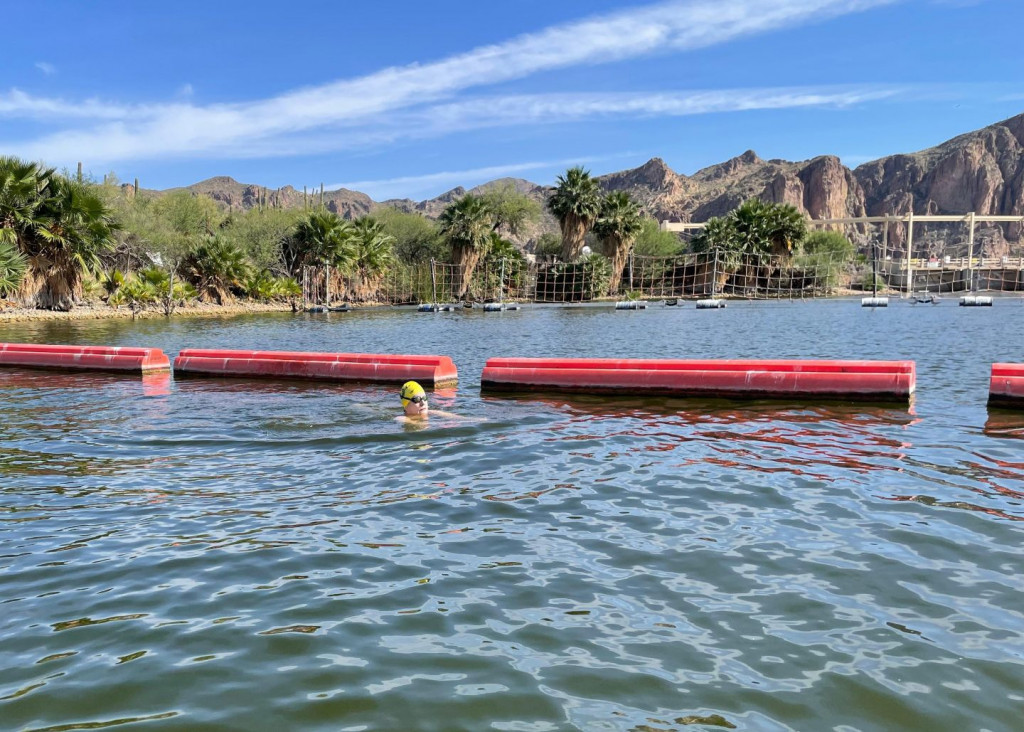
Marti at the finish line. All picture credits Marnie Whitley.