
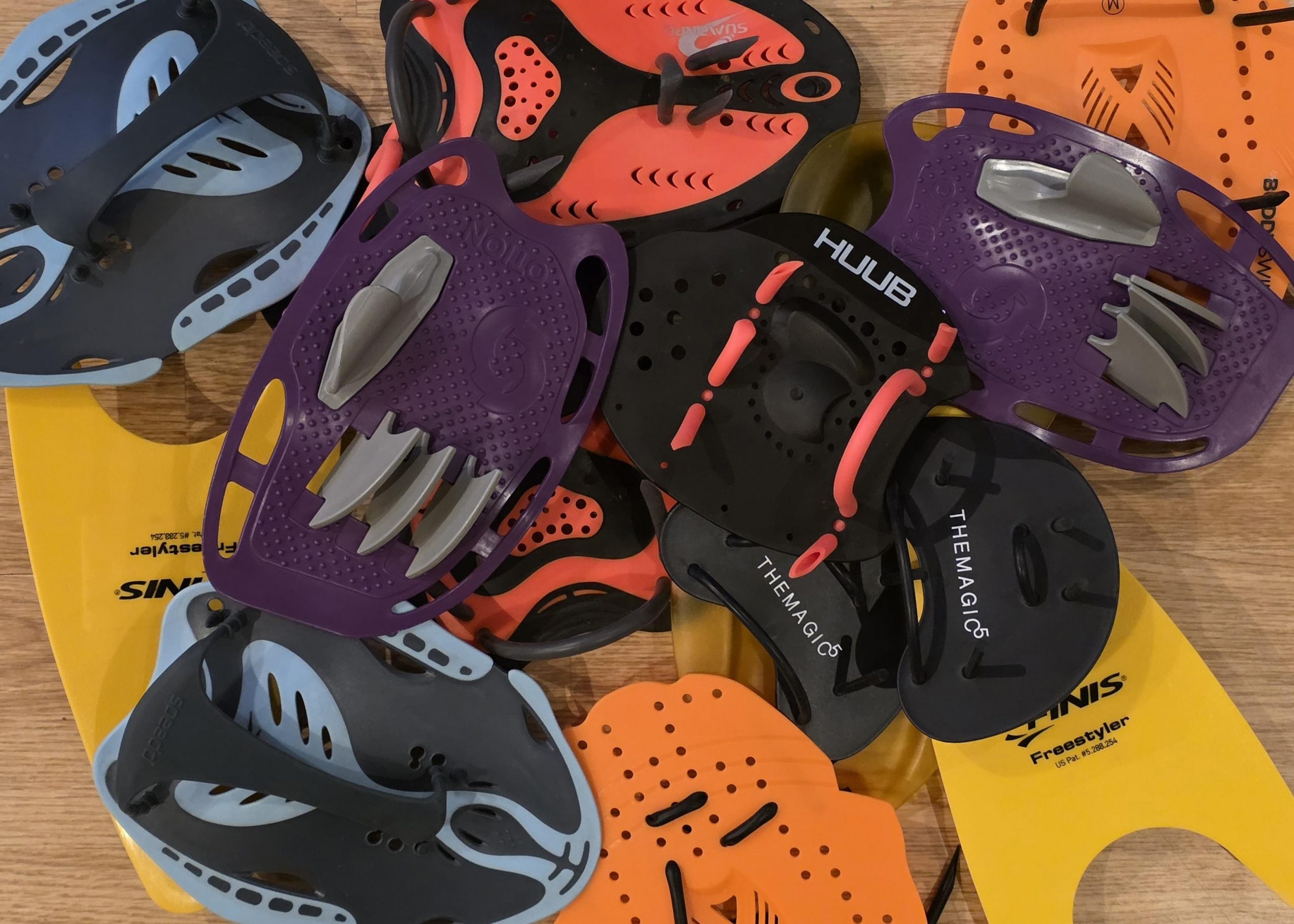
A brief guide to swimming with paddles
One of our Renaissance Swimmer Club members was gifted a pair of swimming paddles at Christmas and asked for advice on using them. Unfortunately, there isn’t a quick and simple answer. It depends on multiple factors, including:
- Your experience and training background
- Your swimming technique
- The type of paddles you have
- What you’re trying to achieve
- If you’re managing or recovering from any injuries
In simple terms, swimming paddles are either designed to help you improve your technique or to build your strength. But naturally, it’s not a clear-cut division and there is some overlap.
Take a look at this short video I made for a brief explanation.
Paddles for technique
In principle, almost any type of paddle can be used to help you improve your swimming technique. However, some paddles have specific features intended to enhance particular aspects, such as hand entry alignment or the “catch” (the first part of the stroke where you get hold of the water).
The important point to note is that paddles – including technique-specific ones – do not provide magical fixes. Rather, they provide feedback that helps you make appropriate adjustments.
Here’s how I suggest using technique paddles.
- Make sure you understand what technique point the paddle is designed to help you with.
- Swim for a few minutes without the paddles but focusing on that technique point.
- Put on the paddles and swim mindfully for a few minutes, staying focused on technique.
- Remove the paddles and again swim mindfully, noticing what is happening to your hands and arms, and how it’s different with and without the paddles.
It’s better to do a series of short swims – say 25m or 50m repeats – than a long continuous one. Take short breaks to ensure you can stay focused and swim without fatigue.
Paddles for Power
Paddles add resistance. The bigger the paddle, the more the resistance. Training with resistance is supposed to build strength and power.
But be careful. To swim faster, you need to apply force in the right direction. If your technique is poor, it’s likely that you don’t always apply forces correctly. Adding power will therefore not help you and may result in injury.
You may see swimmers covering significant distances with paddles. I wouldn’t do this initially. If you’re new to swimming with “power” paddles, I’d start like this.
- Swim gently for 5 to 10 minutes to warm up. Focus on technique. In particular, be mindful of the first part of the stroke (the catch).
- Put on the paddles and swim for a few minutes. Focus on technique and keep the stroke light – don’t try to power through the water.
- Remove the paddles and complete your session without them.
- Once you have some experience, you can swim for longer and apply more force to the water – but don’t rush this.
- Start with small paddles.
- If you notice any soreness in your shoulders or elbows, stop!
What about the pull buoy?
You often see swimmers combining paddles with the use of a pull buoy – a type of float you hold between your legs.
This has some advantages. It holds your body in a more horizontal position in the water and allows you to focus on your hand pathways. As the pull buoy stops you from using your legs, it tends to reduce effort and lower your heart rate. Swimming with paddles and a pull buoy can therefore be very relaxing.
On the other hand, maintaining a full-body connection and timing your kick with your catch is important for efficiency. Swimming with a pull buoy can cause a disconnect between your arms and legs, and may reduce core engagement and body rotation. When you return to swimming normally, make sure you focus on these to ensure you maintain good timing, posture and rotation.
If you want to combine using paddles with a pull buoy, it’s fine, but try to do some of your paddles swimming without.
Power sprints
If you train for strength in the gym, you would typically do a small number (3 to 15) of high-intensity reps. You could try the same idea in the pool with paddles. Instead of swimming a long, steady distance with them, do short sprints – say 15 to 20m – with lots of rest.
Again, be careful. Technique often gets worse when you try to sprint, so stay focused.
All strokes?
It’s easiest to use paddles for front crawl and backstroke, but you can work with them on any stroke – although butterfly is challenging. Some technique paddles are designed for front crawl only, so be aware of that.
Pool rules and etiquette
Some swimming pools have rules against using paddles in public swim sessions. You may have to join a coached session or a club to be able to use them. Other pools are more relaxed. Be aware that you can hurt other swimmers with paddles, so please be careful and considerate.
Technique before strength
Poor technique is often a bigger limiter to speed than lack of strength. Of course you need power to swim fast, but that power has to be applied correctly. If you’re new to paddles, use them with caution and keep your focus on technique – even if you’re using power paddles.
Paddles can be a useful addition to your kit bag but they are not essential. Unfortunately, I often see people using paddles inappropriately. It’s better not to use them than to swim with them badly. If you do use them, do so mindfully and with focus. That way, you’ll improve both your technique and your strength.
