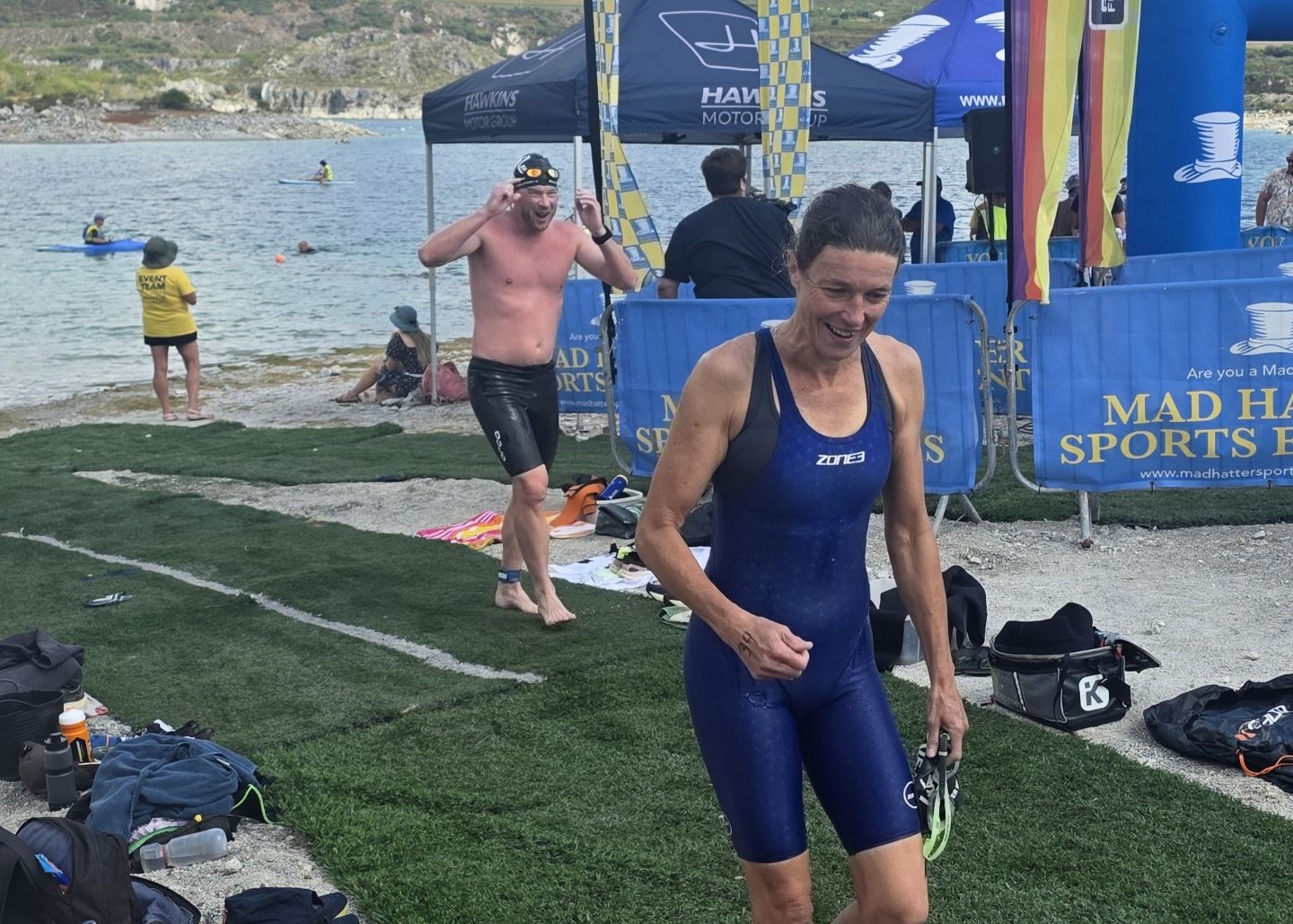
Lucy Young was struggling with back stiffness, but decided to race anyway. What happened?
Like many others, it feels like I regularly sign myself up for an ambitious event, then fail to fit in the training I envisaged. In addition, I frequently find myself carrying a niggling injury: a badly timed cricked neck or a whole host of other ailments that might leave me feeling below par, just at the moment I want to feel strong. That’s life, obviously.
Sometimes, these barriers mean you simply have to pull out of an event. You may have no choice if your body needs to recover rather than race. If you are sporting a plaster cast, it simply isn’t feasible. If you are running a fever, it probably isn’t wise. It may be disappointing to let an event pass you by, but ultimately it will feel like the right thing to do, especially if you are going to do more harm in the long run. Sometimes you just know, in your heart, it isn’t the right thing to do.
However, recently, I made the opposite decision. I went ahead with the Kaolinite Aquathlon, even though I was struggling with a back spasm that made it hard to even stand up straight, and even though running training had basically fallen off my radar. You may think this was crazy, as a 3km swim, followed by a 15km run, is pretty ambitious for me, even when fit, but it was a decision which paid off, as I scraped onto the podium.
I absolutely loved the swim, and 15km of running around a fairly desolate disused quarry somehow fixed my back. I certainly surprised myself, and the sense of achievement has been heightened because I really did think I would have to sit this one out.
It is important to emphasise that this wasn’t a totally reckless decision. My back spasm wasn’t caused by a dramatic accident, so I was fairly sure it was just a muscle spasm making me feel like I had a vice clamped to my lower back. I had done this event once before, so I knew what I was letting myself in for. I have completed two challenging swimrun events already this summer, so I knew I wasn’t totally out of shape. I had done plenty of swimming, both in the pool and in the sea, in the run-up to this event, so the swim wasn’t intimidating me. I also had a plan.
Phase One: ‘Test the water’
On arrival, I spoke to the welcoming ladies at registration so that they were aware of my concerns. I told them I was confident I could complete the swim, but I was likely to pull out of the event after that, rather than launch into the run. The last thing I wanted was to be a liability out on the course, as the route takes you up on the trails high above the quarry, the marshals are spread quite thin, and there isn’t much vehicle access. The response could not have been more accommodating. It ran something like this: ‘You poor thing…how did you do it…well, give the swim a go…see how you feel….but, if you have to pull out, just tell one of the marshals.’
There was something about their tone that made me feel reassured. Even if my swim was slow, they were going to support me. And to be honest, that inclusivity is a big part of this event. All options are available at the point of entry. Swim only (1.5km or 3km), run only (15km), Aquathlon Solo (3km swim followed by 15km run) or relay pair (one person does the 3km swim, the other completes the run). Something for everyone. The atmosphere is relaxed, and the water could not look more inviting. So, I went for it.
Phase Two: Select my kit
I opted to swim in my Zone 3 fast suit, rather than a wetsuit. To be honest, this wasn’t a hard decision.
The thought of hauling a wetsuit on was making my back spasm feel worse, but I generally prefer swimming skins. The water was a comfortable 21 degrees; I knew I didn’t want my legs to be too high in the water, and I wanted to minimise back strain in transition if I did decide to launch into the run. Hauling a wetsuit off was even less tempting than putting one on. So, the fast suit was a perfect solution. I put a sports bra on underneath, so all I had to do in transition was put on a T-shirt (to display my number) and my trainers, and grab some jelly babies to get me going.
Phase Three: Devise a strategy
Nothing very technical here, but I did think about it. I planned to swim at a steady pace, and build if I could. I deliberately positioned myself at the edge of the pack in the water while we waited for the start, so that I had space. I decided to remain open-minded about running and to defer that decision until the transition area. I committed to enjoying the swim, as this was likely to be the only part of the event I could manage. But I did ponder the three best moments to pull out, if I had to. That was, straight away, at the end of the swim, or at the top of the slope that took you up to the start of the trails from the water’s edge, or finally at the first marshal checkpoint, which was still close to the car park. These were the places where I could pull out without causing major problems for the event organisers.
How things unfolded:
The cool, clear water definitely started to ease my back, but I could barely kick my legs at the start, and I had to move even further to the side when a couple of swimmers crashed into me. Sighting put strain on my back, so I kept this to a minimum, and I didn’t panic when the speedy men in wetsuits and the bionic women racing skins in the 3km ‘swim only’ event left me behind. I was just so happy to be in the water, making progress around the course. I tuned into my body (and decided it was a touch of nerve pain down my left side, rather than the cold setting in) and maintained a steady pace.
I exited the water with caution, paused to chat to the marshal, sat down to pull my trainers on, and grinned back at race director John (Yelland) when he jokingly reminded me over the microphone that this was ‘supposed to be a race’. I was still deciding.
Luckily for me, my son was waiting with a camera and encouragement at the transition. He’d already smashed the 1.5km swim, so I high-fived him, and he said, ‘you’ve got this, Mum, just give it a go.’ I set off pretty stiffly, but by the time I’d made it to the top of the slope, I’d already overtaken someone, and I was holding my back straighter than I had done for days. I turned onto the trail and locked in.
I can’t claim the run was easy. My thighs felt pretty hammered by the time I got to the final slope back to the finishing arch. The winning lady (Jo Meek) bounced past me like a gazelle at the midway point, and Lucy Longbottom cruised past me at the 12km mark, pushing me into 3rd, but that didn’t upset me. I was all in, enjoying the views and in disbelief that I was going to make it around the full course. In any case, I am pretty sure they deserve to be stronger runners than me, given my derailed training plans.
I finished this event totally elated, and so pleased that I gave it a go on the day. If you’d seen me trying to climb out of my tent in the morning, you wouldn’t have rated my chances. I could easily have stayed home, nursed my back and continued moaning at Simon (who had encouraged me to enter the full event, when I was pondering doing the swim only). If I had done that, I would have totally missed out, and I would probably still be struggling with my back.
It turns out, you can sometimes complete endurance events, even if you are not fully fit on the day. But don’t launch into them in a reckless way. Choose your kit carefully, devise a plan, tune into your body, adjust your expectations and set out to simply enjoy the opportunity. If you do all of these things, you might just surprise yourself.
I know I did.
When to give it a go, and when not to
Go:
- If the event allows you to ease in and pull out safely if you feel you can’t continue
- You’ve adjusted your mindset from “finish this at all costs” to “give it a go and see what happens”
- The injury or illness is unlikely to be made worse by doing the event
Don’t go
- If taking part puts you or others at risk, or would create significant problems for organisers if you had to withdraw
- If there is a risk you will do serious or long-term damage to yourself
- If your instincts tell you not to
You can find out more about the Kaolinite events here.
Main image (c) Ed Young