And what I got wrong…
UltraSwim 33.3 #2Montenegro, Day 2. I’d loved my two swims the previous day. I felt like I’d paced them well – perhaps even a little cautiously – and I was excited to see what I could do on this first longer swim of around 7.5km.
On Day 1, I’d been conservative with my pacing. My plan for Day 2 was to start faster, find a group of stronger swimmers to draft behind and get a tow for as long as I could. It’s a tactic I’ve followed multiple times, often successfully.
The worst that could happen, I thought, was burning too much energy early and suffering later. But I’ve been there before and dealt with it.
Nothing in my swimming experience prepared me for what did happen, which may have been a classic case of Swimming Induced Pulmonary Edema (or SIPE).
It was a beach start. I took a position to the right of the pack as my preferred breathing side is to my left, and I wanted to keep an eye on the swimmers I planned to follow. The start signal sounded, and I set off, smooth and strong. I was feeling great.
Until suddenly I wasn’t.
Perhaps 100m in or so, I noticed my breathing was a little ragged. It didn’t worry me. This was the point where I’d planned to merge into a pack and settle into a sustainable speed.
But then I started feeling dizzy too. That’s not right, I thought. I was more curious than alarmed. I eased off a little more and the dizziness cleared.
By this time, the swimmers I’d planned to follow had pulled away. No problem. I’ll speed up for a few minutes, get back on their feet, and it will be fine.
Except I couldn’t speed up. My breathing became laboured and I got dizzy again.
It was at this stage, a few hundred metres into the swim, that I realised something wasn’t right. SIPE, although I was aware of it, didn’t occur to me. And I wasn’t coughing blood or anything dramatic. Perhaps I was just more tired from the previous day’s swims than I had assumed.
It was decision time, and with the benefit of hindsight, I chose wrong. I kept on swimming.
My thinking was this. This is a four-day event. You need to complete every swim to get your finisher’s medal. It doesn’t matter if I fall down the rankings today. I’ve got two more days to make it up. Keep going and come back stronger tomorrow.
The swim became an ordeal. I found a pace where I could continue, but it was slow. Other swimmers came flying past. My breathing was laboured and my arms heavy. Still, at the feed station, where I could easily have pulled out, I said I was fine.
Swimmers can be stubborn and stupid, and I think we need to recognise that in ourselves.
When I finally reached the finish line, I was more drained than I’ve ever been after a swim. This wasn’t the happy exhaustion and relief of finishing a long swim, or the burning heart and lungs you get from a sprint finish. It was a sense of hopelessness and emptiness.
The top half of my lungs felt blocked, as if I couldn’t get enough air in. I get asthma and have experienced breathing difficulties before, but this was different. Also, I had a strange sense of pressure around my midriff, which is another symptom of SIPE, although I didn’t know that at the time.
What I did know then, as I floated on my back watching the clouds, was that the event was over for me. But I wasn’t ready to admit it yet. Some hope still lingered. Maybe those symptoms would clear up as soon as I got out of the water and ate something.
Over lunch, that hope began to fade. I could barely walk up the stairs and I had no appetite.
In the afternoon, we were scheduled for another 2km swim; two laps of Mamula Island. It was untimed, but part of the overall event. Skip it and you wouldn’t get your finisher’s medal.
Great, I thought. I’ll go as slow as I need and then recover in the evening, ready to race again the next day.
I told you swimmers can be stubborn and stupid.
The swim became the most miserable one I’ve ever done. A few strokes in, I discovered my breathing couldn’t support even the slowest front crawl. I switched to breaststroke, and mostly head-up breaststroke. I just needed to get around. Time didn’t matter.
The conditions were rough and relentless – even the strongest swimmers found them hard going – and doing head-up breaststroke was close to torture. The waves kept throwing me around and smacking me in the face, and I had no strength to respond.
Somehow, I made it around, but I could barely stand at the end. I was pale and jittery, and puzzled. What was this? By this time, SIPE had crossed my mind, but I dismissed it. I wasn’t coughing up pink foam. Besides, it’s something that happens to other people, right?
By evening, I still felt bloated and breathless. Even a single flight of stairs felt like a mountain. I told the race director I was considering withdrawing (although it was barn-door obvious that I had to) and went to see the event medic. My blood pressure was elevated and my heart rate was around 90 beats per minute – almost double my resting heart rate. Something was wrong.
We discussed SIPE and the doctor listened to my chest. He couldn’t detect any signs of fluid in my lungs. And while my heart was beating fast, he didn’t notice any irregularities. My oxygen saturation was in the low to mid 90s – slightly worrying but not critical.
He advised me to go to hospital for an X-Ray and ECG but I declined. I felt the better option was simply to go to bed and rest rather than face a long journey and an unknown wait in A&E.
The next day, the symptoms were the same and I formally withdrew. In the end, it wasn’t a difficult decision – I felt so wretched – but it still pained me. I suddenly felt detached from the other swimmers. No longer part of the same experience. I wouldn’t get to share the joy of finishing. But I had to put that aside and keep smiling.
I did my best to make the most of the two final days. I joined the media boat and helped the photographer. It was great to see the swimmers at all stages in the race, and the differences between those racing hard at the front and ones having a more sociable and supportive experience further back.
I hoped I might be well enough to rejoin for the final day but there was no way. Sometimes we really do have to listen to our bodies and be sensible, but it’s hard.
Was it really SIPE?
We will never know. I went to my GP as soon as I got back to the UK. He was gracious enough to admit he’d never heard of SIPE and Google searched it while I was with him. He thought it was a plausible explanation. He sent me for a battery of tests – chest X-Ray, ECG, Echogram – but nothing came back abnormal or worrying, which was all reassuring. SIPE often leaves no trace after recovery but remains the most likely explanation.
Second attempt
When something like this happens, it doesn’t just affect you physically. It leaves a mental scar.
Six months later, I was in Croatia for another UltraSwim 33.3, and I was hyperalert to any symptoms. So much so that I probably psyched myself into them. I was so alarmed that I pulled out of the second swim at the first hint of breathlessness. I probably didn’t need to, but that’s the way our brains work.
Last year, I went back to Montenegro and tried again. This time, I chose not to wear a wetsuit. Wetsuits are a possible contributing factor in SIPE due to increased pressure around the chest.
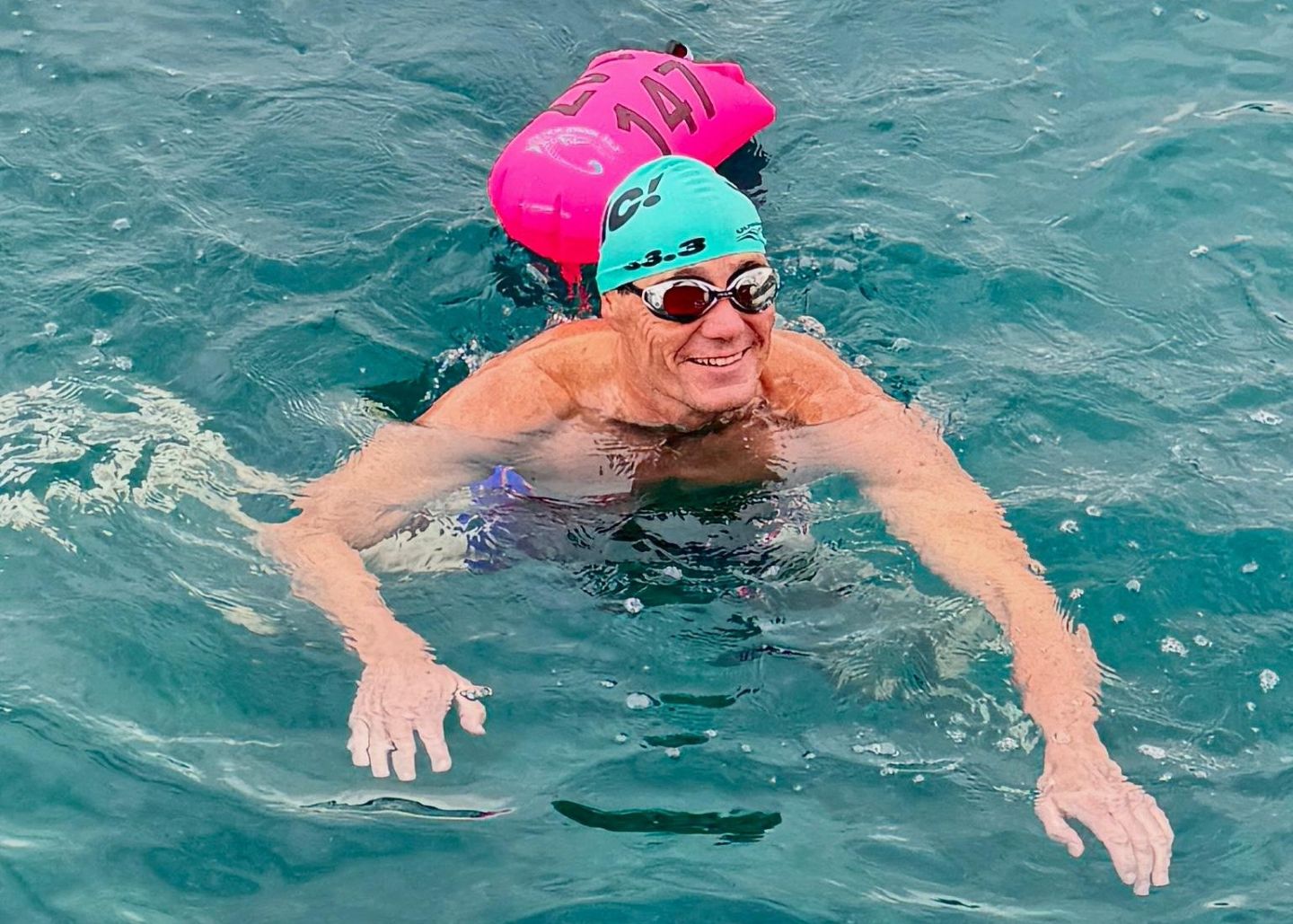
I’m pleased to report that I completed the full distance without any trouble (well, apart from tired shoulders) and had no trouble with my breathing.
Find out more
To learn more about SIPE, check out this article from UltraSwim 33.3