
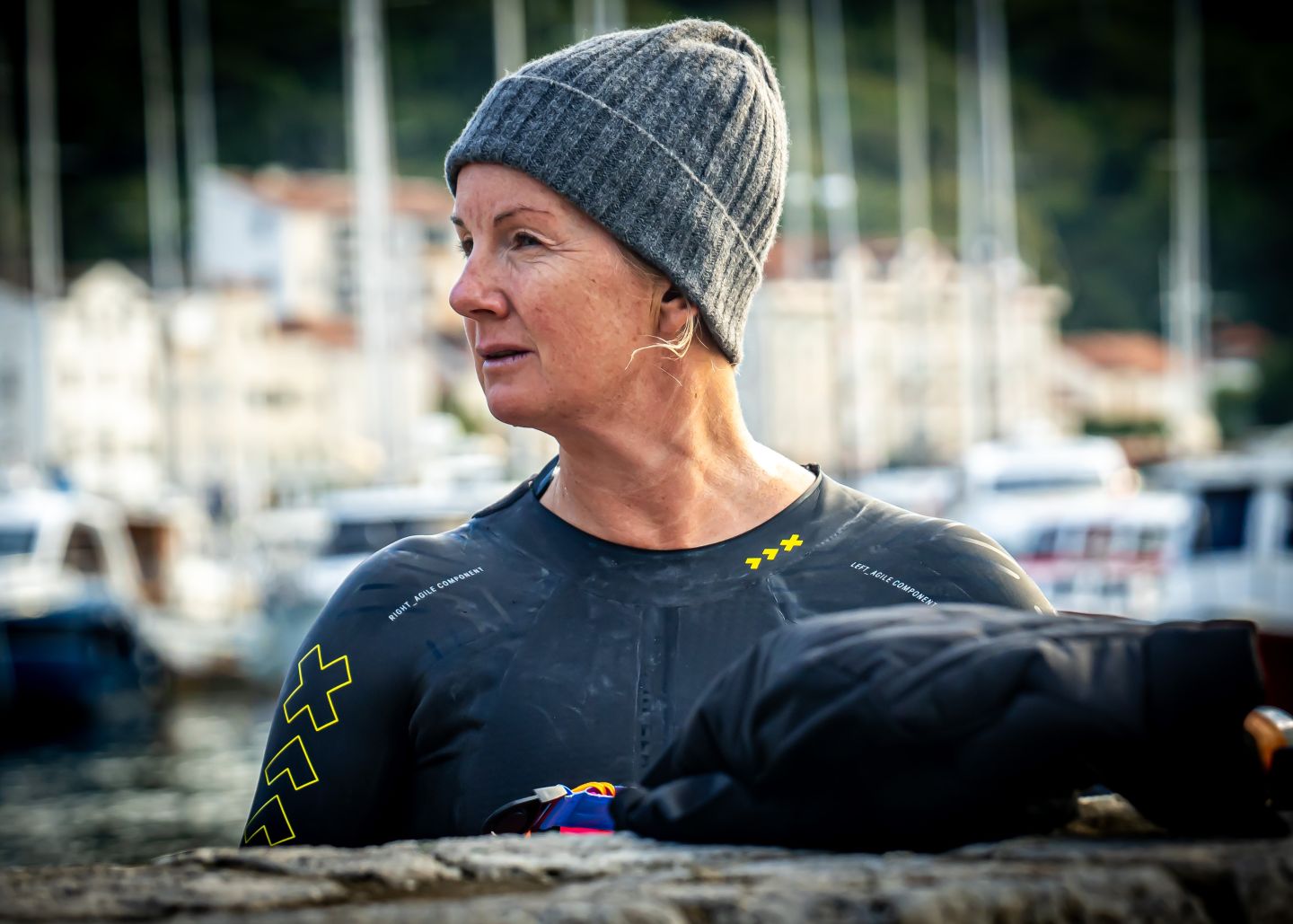
(Image: Anna-Karin at UltraSwim 33.3 (c) John Ross Svensson / Ultraswim 33.3)
From Olympic Breaststroker to Technique‑Obsessed Open Water Coach
I caught up (and swam against) Olympian and top swimming coach Anna‑Karin Lundin at UltraSwim 33.3 Montenegro in October 2025 and persuaded her to reveal some of the secrets behind her speedy swimming.
It’s been great swimming with you the last couple of days, although slightly annoying when you leave me behind near the end each time! What inspired you to sign up for UltraSwim 33.3?
AKL: I’m not a long‑distance open water swimmer. I’ve always been a 100m and 200m breaststroker. But I like challenges, and this was a challenge. Mark [Turner, co-founder of UltraSwim 33.3] had contacted me a couple of times, and the event looked amazing, but I wasn’t ready to sign up. Then we started talking about a possible collaboration, and I thought: I coach long‑distance swimmers – why do they do these long swims? I wanted to understand what they experience and show them that I know what I’m talking about. It makes me a better coach.
What do swimmers come to your coaching camps for?
People come for lots of reasons: adventure, togetherness, to challenge themselves, to meet new people, to see new places, to experience nature. Sometimes I just let them swim. Other times, I coach every millimetre of their stroke.
How did you train for UltraSwim 33.3?
I trained for it, but I didn’t do the 12 km sessions; they just didn’t quite fit into my life or my motivation at the time. Instead, I focused on solid 6 km sessions where I could stay engaged and finish strong. I’ve learned that I enjoy building into the effort and having something left at the end.
My week was usually one threshold session, one open water swim, one endurance session and one technique session, around 15–17km a week. When I started in June, my threshold pace was around 1:29 per 100m, and by the time I arrived here, it was around 1:20.
Now you’re here, do you think you should have done those 12 km training swims?
I don’t think it’s necessary to swim the full distance all the time. I trusted the work I had done. Of course, you can always wonder what more volume would have given, but for me, this felt like the right balance.
How much swimming were you doing before you started training for this event?
The best part of not competing anymore is that I can do what I want. My swimming comes in waves. Before I started training for UltraSwim 33.3, I was lifting weights but not swimming much. I actually stopped swimming at 19 because I just wanted to live a normal life and live like everyone else.
Then, in 2010, the Masters World Championships were going to be in my hometown, Gothenburg. I thought: will I do it? I didn’t know, but I could try, on my terms. I trained four sessions a week for six months and almost matched my times from when I was 19. If you’re happy, you can do magic.
How did you become a coach?
When I was training again, some triathletes asked if I could help them. That’s when I realised that being a good swimmer doesn’t make you a good coach. I didn’t know why we did what we did when I was younger. I didn’t understand the whole picture, and that’s super important. So I went to the US to learn from Terry Laughlin [the founder of Total Immersion Swimming]. He taught me how everything links together. It was totally new information for me. I then became a Swim Smooth coach too.
After a couple of years, I developed my own approach. Every method has something to offer, but everyone is different, so I use what works for each swimmer. Technique is my passion. I love technique, and I love helping people.
And finally, how is this event living up to your expectations?
The first day wasn’t fun. I started too slowly and didn’t know what to do: I felt a bit lost mentally. The second day, I chased too hard and didn’t enjoy it either. But today [Day 3 – 11km straight swim] I started in gear one and worked my way up through the gears. That was fun. I was so happy crossing the finish line. Today I’m having a blast.
What I learned from my discussion with Anna-Karin
You don’t need to perfectly mimic race distance in training
- Consistency and purposeful sessions (threshold, endurance, technique) are enough to prepare for long events. You don’t need to do the full event distance.
Technique matters as much as fitness – but technique is also personal
- Anna‑Karin emphasises understanding why techniques work, not just copying drills, and adapting coaching to each swimmer’s individual needs.
Finishing strong is a strategic mindset
- Training to pace well and build through the gears on long swims can create confidence and allow you to overtake later in the race rather than fade.
Enjoyment and mindset drive performance
- When she trained on her own terms for Masters Worlds, she nearly matched her teenage times: “If you’re happy, you can do magic.”
Coaches benefit from experiencing what their swimmers face
- Doing a long open water challenge herself helps her better understand and support the swimmers she coaches.
Find Anna-Karin
- Website: https://www.simcoachen.se/
- Instagram: www.instagram.com/simcoachen
Join us at UltraSwim 33.3 #16Montenegro – October 2026
Anna-Karin and I are running a “Prep Camp” together ahead of UltraSwim 33.3 #16Montenegro. Join us for three days of pool and open water skills practice ahead of this epic challenge. On the camp you will:
- Receive personalised technique advice
- Practise open water skills on the event course
- Create a plan for the event itself
- Be ready to start the challenge with confidence
Find out more
