Swimming with the current will help you more if you’re a slower swimmer
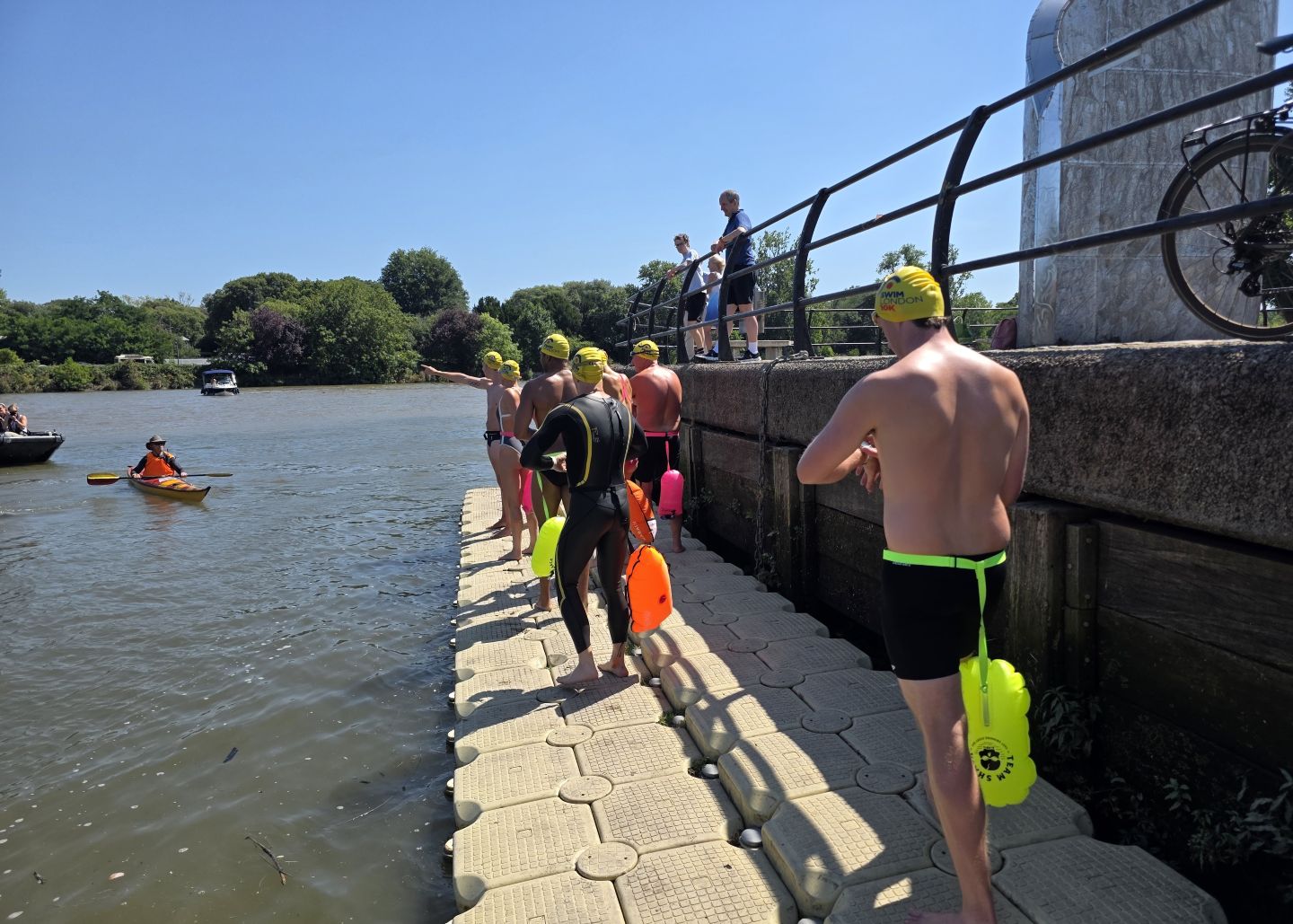
Recently, I completed a 10km swim in the Thames in around 90 minutes. But I haven’t become superhuman. I had a massive boost from an outgoing tide.
The swim was a test for Swim London, an event taking place in September, and you can read more about that trial swim on Outdoor Swimmer.
A few people who are considering the event have asked me what the impact of the current on their swim time might be, so I’ve dived into the numbers.
If we had done the swim in flat water, I guess it would have taken us about 2 hours 45 minutes. This is equivalent to around 1 minute 39 seconds per 100m (we paused to chat a couple of times), or a speed of 1.01 metres per second (100/99).
Our actual pace was around 54s per 100m, which is 1.85 m/s (100/54).
This means the river increased our speed by 0.84 m/s (almost 2 miles per hour) and reduced the time required to cover each 100m by 45s.
The table below shows the estimated time for a 10km swim at different flat-water paces, and then the estimated time with the same current assist of 0.84m/s.
| Flat-water pace | Flat-water 10km time | Speed in flat water | Estimated 10km time with current assist |
| 1:15 per 100m | 2:05 | 1.33m/s | 1:17 |
| 1:30 per 100m | 2:30 | 1.11m/s | 1:25 |
| 1:45 per 100m | 2:55 | 0.95m/s | 1:33 |
| 2:00 per 100m | 3:20 | 0.83m/s | 1:40 |
| 2:15 per 100m | 3:45 | 0.74m/s | 1:45 |
| 2:30 per 100m | 4:10 | 0.67m/s | 1:50 |
| 2:45 per 100m | 4:35 | 0.61m/s | 1:56 |
| 3:00 per 100m | 5:00 | 0.56m/s | 2:00 |
How the sums work
Consider a swimmer who normally swims at 2:00 per 100m. They cover 100m in 120 seconds, so their flat-water speed is 100 ÷ 120 = 0.83m/s.
Add the estimated current assist: 0.83m/s + 0.84m/s = 1.67m/s.
The estimated time for 10,000m is therefore 10,000 ÷ 1.67 = 5,984 seconds, which is just under 1 hour 40 minutes.
Incidentally, if you don’t swim at all, and just let the current carry you, you’ll cover the 10km in just under 3 hours and 20 minutes – a pretty respectable time for a swimming marathon.
Times compressed
What stands out here is how slower swimmers gain more than faster ones. Everyone would still finish in the same order, but the times are compressed. In still water, there would be nearly a 3-hour difference between the slowest and the fastest swimmers we’ve looked at here. If our estimated current assistance is correct, that gap narrows to around 45 minutes. And if my estimate of the current is too low, the gap will narrow even further.
What if the tide were against you?
It’s worth noting what would happen if the swim were reversed and we had to swim against the current. While slower swimmers gain more when swimming with the current, faster swimmers do better when going against the flow. In fact, in this scenario, you would need to swim faster than 2 minutes per 100m to make any progress at all. Even if you could hold a pace of 1:30 per 100m, it would take you more than 10 hours to cover the distance – and the tide will have changed in this time anyway. An elite, 1:15-per-100m swimmer, could theoretically do it in about 5.5 hours – but I can’t imagine anyone would want to try.
Other factors
Swimming downriver at speed is a lot of fun, but if you’re racing, you need to do a bit more than simply go with the flow. To achieve the fastest time, you need to read the water and navigate the currents. The flow is not the same wherever you swim. It’s typically fastest in the centre of the river and slowest by the bank. But it’s also disrupted by obstacles such as bridge piers. It sweeps around the outside of bends faster than the inside.
However, for safety reasons, swimmers will not be able to use the full width of the river, so you will not be able to take full advantage of this knowledge. Instead, you will be guided down a relatively narrow corridor close to the right-hand bank. Still, even here, there will be a difference between swimming closer to the middle than hugging the bank.
Finally, watch out for navigation buoys and other obstacles. Consider sighting more often than you would in still water because of your greater speed. Keep well clear of any structures or tree branches in the water as these will slow you down much more than slightly getting your line wrong.
It’s unusual to do an organised swim with this much current assistance. Enjoy the ride and expect a much faster time than you’re used to.
A few footnotes…
- I may have over-or-under estimated the current. I think it’s more likely that I’ve underestimated.
- The current on the day could be more or less than we experienced during the trial.
- For the calculations, I’ve assumed a constant current, but this is not the case. It will vary with time and place.
Find out more about Swim London at https://swim.london/