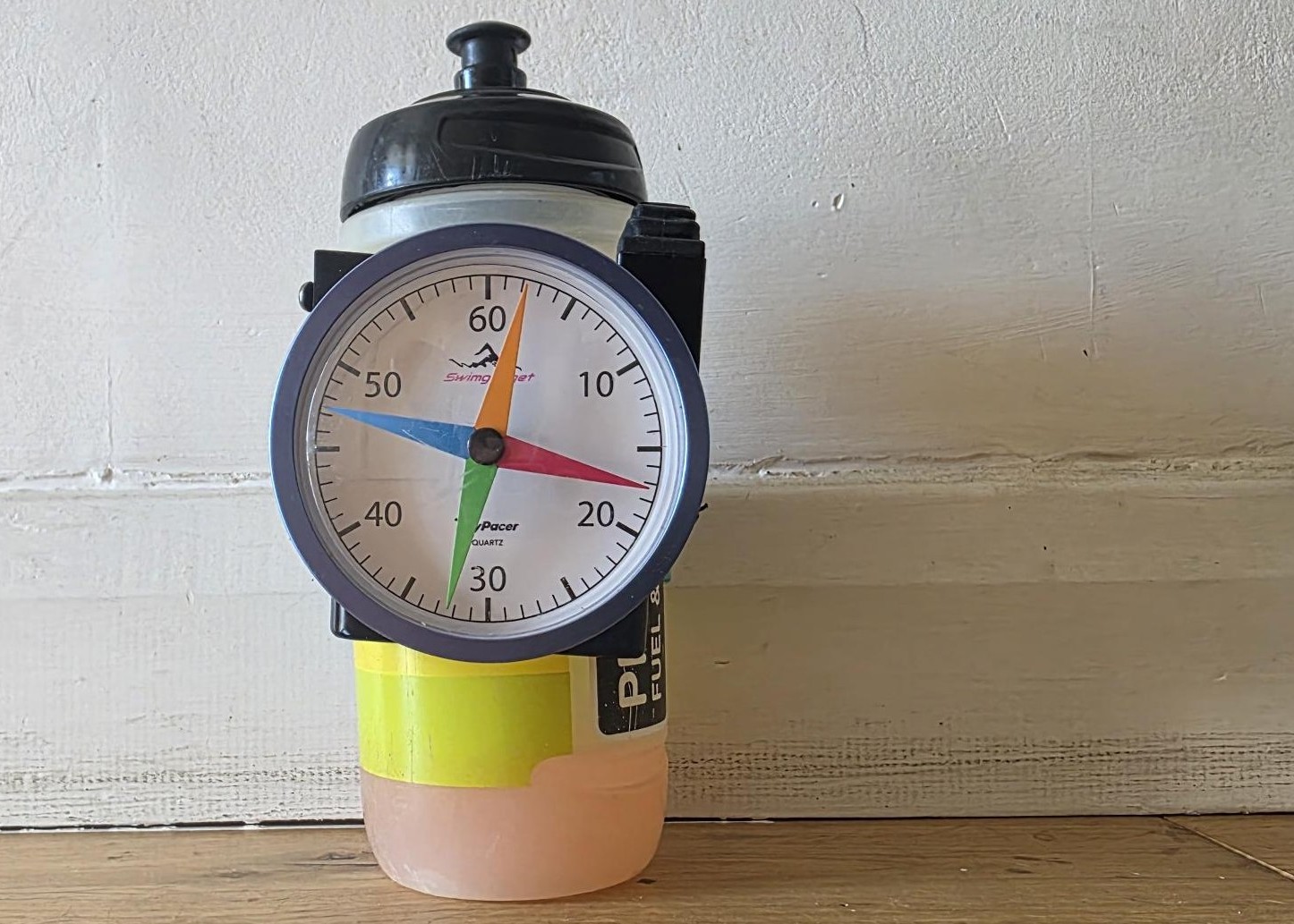
Many coaches use Critical Swim Speed to set training times: Should you?
Have you stumbled across a training set online that used the acronym “CSS”?
For example, you might see something like this and wonder what it really meant, and if it was relevant to you?
10 x 100m @CSS plus 15s rest
Or
4 x 400m @CSS+5 plus 30 seconds rest
In the swimming world, CSS usually refers to Critical Swim Speed, a concept that derived from sports science research in the 1990s, drawing on the idea of critical power in cycling. Over time, coaches have adapted it into a practical training tool to guide pacing in threshold and endurance training sets.
It is typically measured by asking swimmers to swim a 400m time trial followed by a 200m time trial (protocols vary, but typically with a 5 to 10 minute rest in between), and then using this formula:
CSS = 200m/(T400 – T200)
Say you calculated your CSS as 2 minutes per 100m. In the first example, you would swim 100 metres, 10 times, on 2 minutes 15 seconds, with a target time of 2 minutes. In the second, you would swim 400m, 4 times on 8 minutes and 50 seconds, with a target time of 8 minutes 20 seconds (2:05 x 4).
Not a magic number
Many coaches (and swimmers) like CSS because it gives them a simple way to prescribe training intensities without relying on perceived intensities. In club sessions, it can be used to manage lane selection and swim order. In daily use, you may hear CSS used interchangeably with terms such as threshold pace, lactate threshold pace or perhaps the pace you could hold for 1500m, or even 3000m. These give you an idea of what CSS is measuring, but they are not precise equivalents.
Your CSS is sometimes treated as a kind of magic number in swimming, as if training at this pace will mysteriously transform your swimming.
In reality, you need to train at a range of speeds and effort levels to make meaningful progress in swimming.
But CSS is useful because it gives you both an anchor point to base your training on, and an easy number to monitor changes in your sustainable swimming speed.
Thus, if a coach wants you to do a long-distance low-intensity endurance swim, they might ask you to swim at a pace of your CSS + 5 or 10 seconds (or even more) per 100m. If they wanted a higher-intensity effort, they might tell you to swim at CSS – 5s (usually with more rest in between intervals to keep this achievable).
But do you really need to know and monitor it?
First, if you’ve never heard of CSS or only have a vague idea of what it is, don’t worry. Many swimmers I speak with don’t know either. And some do know, but they don’t care.
On the other hand, I know swimmers who track their data obsessively, including CSS. They build all their training around CSS and do their best to stick to target paces.
Here’s my take on it: CSS training can be extremely effective and motivating – but it’s not for everyone.
Some swimmers love tracking their numbers. It’s part of what keeps bringing them back to the water and through their training sessions. They relish the challenge of hitting their target times and using the clock to regulate and inform their effort levels.
Others prefer to swim by feel. They might describe their effort levels as easy, steady and hard, rather than in numerical terms. The idea of tracking numbers and using those to inform their training is uncomfortable and off-putting.
A third group take a phased approach. They become data trackers in the build-up to a swimming challenge, and swim by feel at other times. This might be the best of both worlds as it can help you meet your swimming goals without having to monitor and measure every swim.
Tying feel and numbers together
When I work with swimmers, I encourage them to use the pace clock or a watch to get an idea of their swimming speed at different intensities. I find it useful to track pace and how it varies, as improving your pace judgement can be a great way to unlock progress.
For those who are willing and interested, we use CSS to inform training and measure progress. But I don’t insist on it for those who prefer to swim by intuition.
A key skill, I believe, is being able to link your pace to how swimming feels. For example, if you were asked to swim 15 x 100m with 15s rest after each 100m at your maximum sustainable speed, and hitting the same time throughout, would you be able to do that? Would you know how that would feel at the beginning, halfway through and towards the end? Would you be able to reproduce that consistency in a race?
Knowing your CSS can help you do this, but it isn’t essential. If tracking data causes you stress or more work than you want, don’t do it. If a highly structured training program would put you off swimming, don’t worry. You’re more likely to improve by following an approach you enjoy and will stick with.
When CSS is most useful
- Preparing for a race or swimming challenge.
- Following a structured training programme.
- Swimming in a club environment.
- Tracking long-term progress.
When you can ignore it
- Swimming mainly for enjoyment.
- New to training and pacing.
- Finding data tracking stressful.
- Training primarily for pool sprints.