
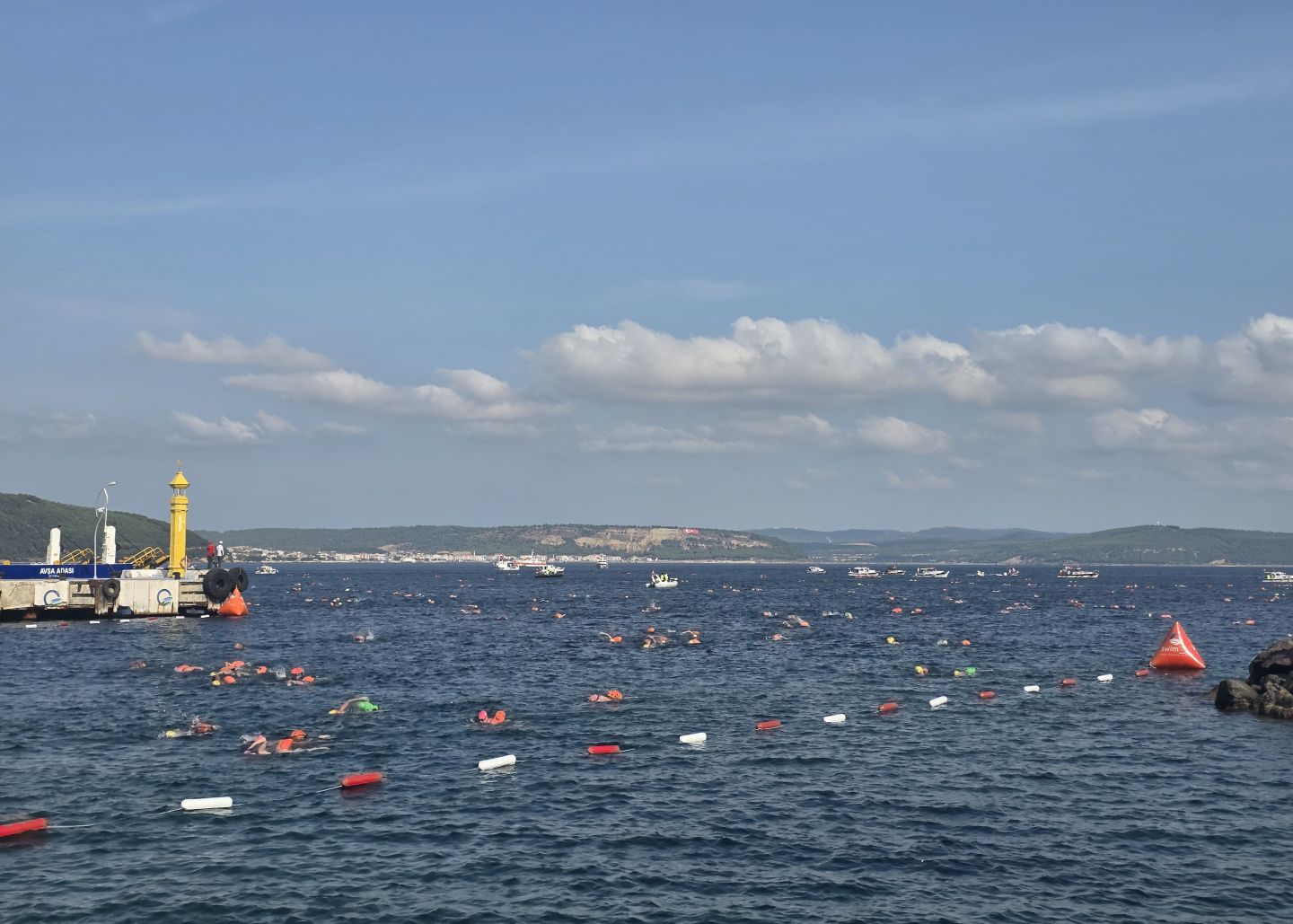
Trying to find the best line across the Dardanelles Strait is tricky. Best not to overthink it.
Last weekend, along with nearly 1,500 other swimmers, I stood on a beach in Europe and looked across the Dardanelles, trying to work out how to navigate the currents and safely land in Asia.
I was taking part in the 39th edition of the Hellespont Swim, surrounded by swimmers with the same concerns as me. There was lots of pointing and discussion in multiple languages. Nobody seemed to be sure exactly what to do, but some swimmers seemed more comfortable with the uncertainty than others.
The Hellespont is an amazing swim for a range of reasons, one of which is the technical challenge of picking the best line, by which I mostly mean fastest, but also the one that minimises your risk of being swept past the finish.
A strong surface current flows through the Dardanelles Strait, from the Sea of Marmara towards the Aegean, accelerating at the narrowest point in Çanakkale, which is where the swim finishes.
The start at Eceabat Beach on the European side is upstream of Çanakkale rather than directly opposite. This means not only do you have to cross the current, but you also get to ride it.
The question that we swimmers were wrestling with was: what is the best line, and how do you make sure you follow it? The shortest route is a straight line, but that might not be the quickest.
Straits and narrows
Imagine swimming across a river and trying to reach a point exactly opposite where you start from. To swim across straight, you would have to angle your body upstream to counteract the current. The stronger the current, the more you would have to point upstream.
On the other hand, if you swam perpendicular to the bank, you would end up downstream of your start. The exact location would be determined by your swimming speed and the strength of the current. Changing the angle of your swim in relation to the current determines where you end up.
The same principle applies for the Hellespont Swim, with complications. The banks are not parallel, and the strait isn’t straight. This means the current varies from place to place. We can make informed guesses about where the current will be strongest, but we can’t know for sure. Adding to the confusion, in some places, the current can flow in the opposite direction. Moreover, it’s hard to know exactly where you are in relation to these currents.
The situation is further complicated because of your swimming speed. Slower swimmers need to angle themselves more steeply against the current to end up in the same place as faster ones.
Another feature of the Hellespont is that there are no intermediate markers. There are no buoys in the middle to aim for or to indicate your route.
In brief, you’re left with a situation where you don’t know exactly where you are, or how strong the current is, and what the best landmark to aim for is. Given all that, the wonder is that nearly everyone makes it across.
You’re not completely alone
While there are no waypoints, safety boats line the main route keeping you roughly on track, although the corridor is wide enough for plenty of discretion on the exact line you follow. Then, with more than a thousand other swimmers in the water, you’re unlikely to be alone. Of course, there is a danger in following another swimmer, as they may not choose the best line. But if there is a group, with several people sharing the sighting, the wisdom of the crowd often prevails. The benefits of sticking with a group usually outweigh the disadvantages.
Rather than a straight line, the fastest route across is probably a flattened “S”. Initially, where the current is slower nearer the sides, perhaps aim further upstream than you need. This, in theory, should give you more time swimming in the faster current towards the middle. Take advantage of this, and don’t head towards the far shore too soon. Then, as you approach the finish, head directly towards it once you’re in the slower current again.
But, in reality, achieving this sort of precision while swimming is almost impossible. There is little point in obsessing over finding the perfect strategy when the conditions are so complex.
A key skill for this swim is therefore managing your navigation in the face of considerable uncertainty and not worrying too much about whether you’ve got it right. You most likely haven’t. But nor, probably, has anyone else. Still, nearly everyone will make it across. So, try to swim confidently despite the uncertainty and don’t overthink it – as I have done here.
Instead, enjoy the swim for its cultural, historical and geographical significance. Take a moment to savour that you’re swimming between continents at what many people consider to be modern Turkey’s spiritual birthplace. And don’t let worries about finding the perfect route spoil the experience.
The challenge of the Hellespont isn’t only about navigation. It’s also about being comfortable making decisions with incomplete information, something you will come across often in your training, racing or on swim challenges.
At Renaissance Swimmer, we explore how to think through those challenges. Not just how to swim faster, but how to become a more thoughtful, independent and capable swimmer.
If you’d like to explore further, start with the Renaissance Swimmer book.
