
How does swimming change, and how do we need to adapt, as we get older?
One of the most popular webinars we’ve run at Outdoor Swimmer was on Swimming into your 50s, 60s and beyond. People often ask us about swimming and ageing: how will it affect them, and do they need to adjust their training?
Conventional wisdom tells us:
- We get slower as we age
- Strength declines
- Aerobic capacity declines
- Injury risk increases
- Neuromuscular coordination weakens
- We need more time to recover from hard training or challenges
- We can’t train so hard
But this isn’t the whole story, by a long way.
Late bloomers
We tend to envy those people who swam as kids. Years of club training gave them enviable technique and a refined feel for the water. But in some respects, people who come to swimming later, or didn’t reach their full potential when young, have some advantages.
Swimming is a skills-based sport. Those skills take years to develop and hone. This gives adult starters the potential for years of motivating improvement and increasing speed that former champions just don’t have.
Moreover, most of us are not at our biological peak potential for strength and fitness. At almost any age, we could be stronger and fitter than we currently are. Our bodies respond positively to training.
The reality is, most of us are far short of world record speeds for our age, so that gives us scope for improvement – and this is especially true if you’re coming back to swimming after a long break.
For example, Denise Robertson, who was born in 1935, only returned to organised swimming at age 65, then went on to first break an Australian age-group record and then the world record in the 1500m freestyle. The latter she set in 2016 in the 80 to 84 age-group with a long-course (50m pool) time of 28:35.98. This record still stands today.
She says, “I surprised myself by breaking records well into my 80s”.
Not only can people who start swimming later in life go on to great things, but they also hang on to their competitive spirit and desire to be the best they can.
Speedy oldsters
On the subject of world records, take a look at some examples, and consider how you compare:
| Age Group | Gender | Distance* and Stroke | Time | Name |
| 80-84 | M | 200m FC | 2:38.35 | David Radcliff |
| 100-104 | F | 200m FC | 7:27.89 | Mieko Nagaka |
| 65-69 | M | 400m FC | 4:45.88 | Jim McConica |
| 65-69 | F | 400m FC | 5:06.74 | Laura Val |
| 90-94 | M | 1500m FC | 30:41.82 | Willard Lamb |
| 85-89 | F | 1500m FC | 30:51.51 | Betty Lorenzi |
*Short course times – i.e. in a 25m pool
Clearly, speed does decline with age. If you scan through the records, you’ll see that some people hold records in multiple age groups, and the times are longer as the years progress. But these times are still faster than people half their age could do. And no, I didn’t make a mistake. Mieko Nagaka races in the 100-104 year age group.
Denise shared how her swim times changed between the ages of 75 and 89.
| Event | Time at 75 | Time at 89 |
| 100m free | 1:27.23 | 1:35.95 |
| 200m free | 3:12.26 | 3:31.03 |
| 400m free | 6:38.65 | 7:27.15 |
| 800m free | 13:43.83 | 15:22.75 |
| 1500m free | 26:57.95 | 28:22.75 |
Look up the world’s best times for your age and gender. Ask yourself, what scope does that give you to improve? How far away are you from your swimming potential?
Relative speed
Even when (or if) you reach a point when you can no longer swim faster in absolute terms, you may still be able to “improve” in relative terms – or at least not slow down as much as your age-peers. Look at the gap between your current swim times and the best in the world for your age. Has that gap narrowed over time, even if you’ve plateaued in absolute terms?
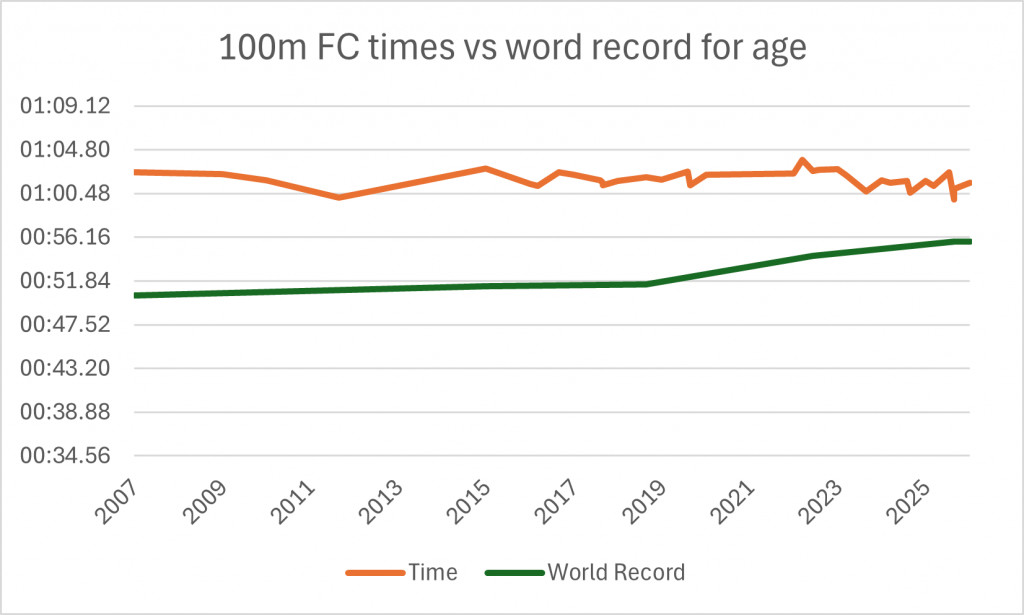
The above chart shows my short course (25m pool) 100m freestyle times since 2007, alongside the world record for that event for the age I was in that year. You can see my times jump around a little but the trend is stable (or, with an optimistic squint, slightly faster). Meanwhile, I’ve got closer to the world record times as those have slowed with age. I’ve moved the gap from 24% in 2007 to about 7.5%.
That fast feeling
Chris Fidler, a swimmer in his 70s, says that although the clock tells him he’s slowed down, he still feels fast in the water. “My 200m FC time has drifted from around 2:29 to 2:40 over the past decade or so, but swimming still feels as good as it ever did.”
However, he added that “if I lost this feeling, I’m not sure if I would continue to train as I do now.”
Still, for now, Chris remains competitive in his age group and has national titles across a range of distances and strokes. He has also been part of several European and British-record setting relay teams.
Trend defying
We can’t avoid the realities of ageing, but we can push back. Swimming gives us lots of scope to do this. We can do sprint training to hold on to strength and neuromuscular coordination, and we can do long swims to preserve our aerobic capacity. The studies that show we can lose something like 15% of our strength with each decade and about 10% of our VO2 max (a measure of aerobic capacity) are population-based. People who remain active and have deliberate strategies to mitigate the effects of ageing, stay stronger and fitter than the averages suggested by these studies.
As an aside, the Renaissance Swimmer approach tackles all these aspects. It’s a healthy-ageing programme as well as a swimming one.
Training adjustments
We have to adjust our training throughout our lives, and for many reasons, including injury, work stress, changing priorities, travel, pandemics and more. But changing your training specifically because you’ve been on this planet a particular number of years doesn’t make a lot of sense.
The amount you can train and how quickly you recover are determined by much more than simply your age. Your training history, general health, diet and overall stress all play a role.
In one sense, you “should” train more as you age, as you’re fighting age-related decline. But training beyond a certain point brings little return and excessive training will likely be detrimental. The trick is to find a balance that works for you. What feels right?
Signals you may be doing too much might be excess and ongoing fatigue, difficulty in hitting your usual times while swimming, difficulty in sleeping or lack of enthusiasm for training.
What other swimmers do
Chris, who was one of the younger swimmers I spoke to, says his training hasn’t changed a lot, but he’s added in more recovery. “The sessions are pretty much the same as before, but the rest intervals are longer.” Outside of the pool, he’s become more diligent with flexibility and mobility work.
Lindy Salter, who was born in 1944, took up masters swimming in 2014 and has since been to five masters world championships. She says: “I train harder than I did as a kid, but I don’t take any notice of my times.”
However, she also said that any training she did as a child was “boring and ineffective!”
Her training now typically consists of three 1-hour sessions each week, with additional sessions in the lead-up to competition.
She also adds, “when racing, I always give it my best shot, right to the end of the pool.”
Another Australian swimmer, Margaret Watts, swam at state level as a child. She said she would have liked to compete in surf lifesaving events too – but women weren’t allowed back then. Now in her 80s, she took up masters swimming 40 years ago.
While Margaret does compete occasionally, swimming is more of a social activity. She enjoys being in a coached session as much for the chat at the end of the lane as for the technical feedback. “I still try to keep my technique up, concentrating on timing, high elbows etc. I know what to do but do I get into bad habits.”
Change is sometimes forced upon us. Denise, now in her 90s, needed a two-year break from swimming after reverse arthroplasty surgery on both her shoulders in 2023. But she’s back and says, “I still have a great love of the sport and particularly cherish the friendships forged from swimming.”
Before her surgery, through her 60s, 70s and 80s, her training consisted of two 1-hour coached sessions per week, covering 2.5 to 3km, and 1 or 2 solo endurance swims working on all strokes. Denise also describes her determination to learn tumble turns in her 60s. When one coach suggested she stick to touch turns in racing, she said: “Red rag to a bull! I practised and practised and NEVER did another touch turn!”
Six months post-surgery, she’s pleased to be back in the pool and keeping up with swimmers a decade or so younger than her and says she’ll probably compete again. But she’s had to change her training. Coached sessions are closer to 1500m now, she’s had to adjust her front crawl technique to accommodate her shoulders, and she can’t “yet” swim butterfly again.
That “yet” is possibly the highlight of these discussions!
Shifting priorities
We all have different paths through swimming. Some people reach peak speed in their 20s, and then gradually slow down over the years. Others take up swimming later in life and often find themselves getting faster for many years. It’s worth bearing in mind that ideas about swimming and coaching have evolved significantly. As masters swimmers, we can tap into this new thinking to unlock speed gains that we weren’t exposed to as youngsters.
But slowing down is, at some point, inevitable.
But just because you can’t swim as fast as you used to, it doesn’t seem to make swimming less enjoyable, and it’s certainly still good for you. The benefits are not only physical, but social too. Every swimmer I spoke to mentioned this latter point, with Denise saying, “I cherish the friendships forged from swimming.”
Margaret says she doesn’t particularly have a “driving spirit” to achieve fast times for herself but is motivated to swim her best in relays as part of a team.
Older swimmers need to learn to switch priorities, as the people I spoke to have clearly done. Instead of raw speed, they take satisfaction from relative performances for their age, how swimming actually feels, maintaining their technique or modifying it to suit physical realities, and the opportunities swimming gives them for socialising.
It’s a complex and nuanced picture, but I think the conclusion is simple: just keep swimming.
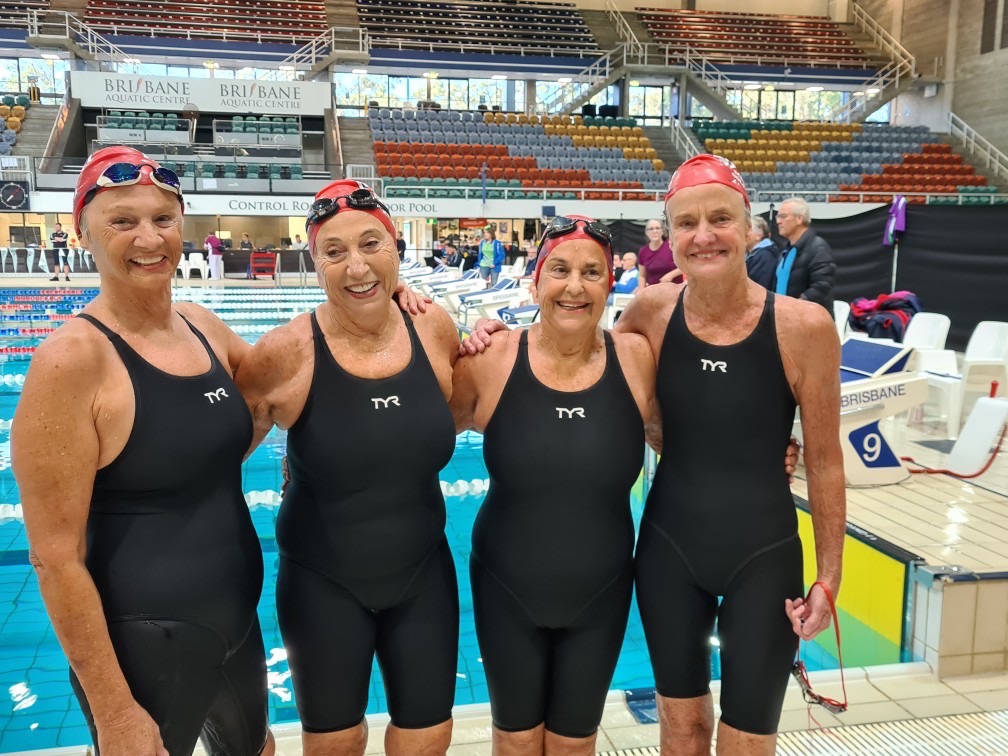
Featured image: Carole Simpson, Margie Watts, Denise Robertson and Margie Fittock after their first world record relay swim
