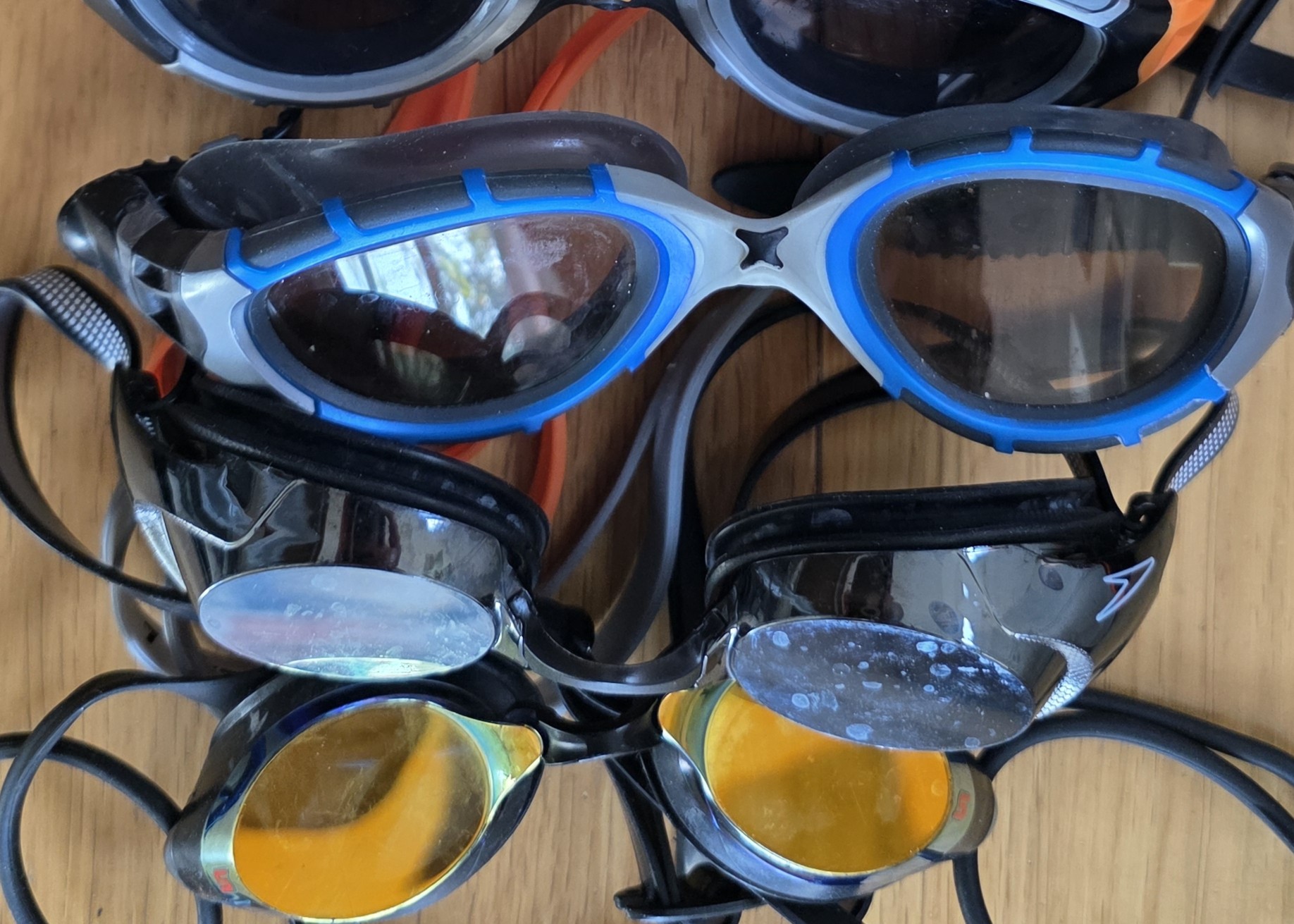
Including tips for glasses wearers and keeping your goggles fog-free
I once did a race with goggles filled with water. It was worse than swimming without. I could barely see anything. It was a 100m individual medley, so there was no way to empty the goggles without breaking stroke and being disqualified. I finished but was so afraid of hitting the wall that I was several seconds slower than usual.
I keep a special pair of goggles for pool racing but I’d picked up my training goggles by mistake, and the strap was too loose for diving. I should have known better.
If this had happened in open water, I could have paused and emptied my goggles. Nevertheless, leaky goggles are best avoided. Even the briefest pause to empty them costs you time and disrupts your rhythm.
When choosing or reviewing goggles for Outdoor Swimmer magazine, this is my top priority.
Second is clarity of vision. This has multiple factors. Indoors, I don’t like any distortion or double vision under the water. Outside, I need clarity above the water. For both, I don’t want fogging. The additional complication is that I’m short-sighted. More on this later.
The next factor is comfort. The longer the swim, the more important this is. A key point here is, how tight do I need the strap to prevent leakage? For the long swims, the looser the better, but not so loose that a rogue wave will send them to the ocean floor. Interestingly, two swimmers can have opposite opinions about the comfort of the same pair of goggles, so always test yourself.
Other things that may matter to you are if (or to what extent) your goggles leave marks around your eyes, if your eyelashes brush against the lens, or if you want digital enhancements.
Too many choices
The above is a long way of saying that goggles have a big job to do. There’s a lot to consider and you may have to accept trade-offs. You’ll also find personal preference plays a big part.
Pool or open water?
You may see some goggles described as “open water goggles”. In most cases, if you have a pair of goggles you’re happy with in the pool, they will usually be fine outside. The two things I would check are: do they provide UV protection, and do they have the appropriate tint for the conditions? Other than that, I know some – but certainly not all – swimmers prefer the comfort of larger lenses and their wider peripheral vision.
One size does not fit all
Personal preference tends to be strongest around the size and shape of the eyepieces. The smallest sit inside your eye socket, while swimming masks can extend from your forehead to your cheekbones. There are pros and cons for each.
Socket Goggles
The smallest goggles sit inside your eye socket. Some – so-called Swedish Goggles – do away with the seal between the eyepiece and your skin. Many top-level swimmers use them, but some people find them very uncomfortable. Swedish Goggles have fully adjustable nose pieces, so they work on a wide range of face shapes.
- Pros: low profile, adjustable, speed-aesthetic, value for money
- Cons: less protection if struck in the face
Eye-Socket Goggles (Racing-fit goggles)
These are slightly larger than true socket goggles. The seal still fits within the eye socket but rests on the orbital bone rather than the soft tissue. They retain the speedy look of socket goggles, but some people find them more comfortable. Rather than being fully adjustable, these often come with a range of fixed nose bridges.
- Pros: Comfortable and sleek
- Cons: Slightly less adjustable
Open Water Style Goggles
The next size up has a bigger, shallower eyepiece and sits on the bone around the eyes. Goggles marketed specifically as open water goggles often come in a range of tints to suit different conditions. Some even have photochromic lenses. Some styles can be tightened while wearing them.
- Pros: Comfortable on long swims. May provide better eye protection if knocked in the face.
- Cons: Can be less secure on dive starts. Some are one-size-fits-all.
Swim Masks
Swim masks cover a larger area of your face (but not your nostrils) and create a large air space in front of your eyes. Some winter swimmers like these as they reduce the amount of skin in contact with cold water.
- Pros: Minimal pressure around the eyes. Unobstructed vision.
- Cons: Size and weight. Can interfere with your swim stroke.
Stop the fog
In my experience, all goggles eventually fog up, even those with anti-fog coatings. Sometimes they are fine for a few swims, but they all cloud over at some point.
You will probably have your own tricks for reducing the fog. The two things that help me most are keeping the lenses clean and scratch free, and baby shampoo.
With outdoor swimming especially, it’s important to rinse out any sand or debris – a single grain of sand can ruin your goggles if you rub it around with a cleaning rag. Occasionally, I give my goggles a deeper clean with washing-up liquid. If you do this, rinse thoroughly before use!
Before each swim, I gently smear a drop of diluted baby shampoo around the lenses, then rinse them once. I then put the goggles on and don’t remove them until I finish the swim.
This is usually completely reliable but sometimes fails due to leakage or if I haven’t kept the lenses clean. If you do get fogging mid-swim, you can try a few things:
- Wait – sometimes the fogging lessens on its own
- Tolerate it – you may be able to see enough through the fogging to complete your swim
- Rinse the goggles – gently lift your goggles and dip your face in the water. This clears the lenses, but the relief is sometimes temporary
- Keep some water in your goggles – repeat step 3 but instead of letting all of the water out, leave in a small amount. This sloshes around while you swim, keeping the lenses clear – but can cause eye irritation.
Note that some goggle brands recommend against putting anything on your lenses, including baby shampoo, as it can degrade the anti-fog coating. This may be true, but I know many swimmers do this, and it works fine for me.
Glasses wearers
You have three options. Use regular goggles and cope as best you can, use prescription goggles, or wear contact lenses under your goggles.
But please note: any optician would recommend against the contact lens option because it increases the risk of acanthamoeba keratitis, which is rare but can result in loss of vision (this is not theoretical – I know someone who has lost an eye). If you must wear contact lenses, use disposable ones, try to keep your eyes dry, and remove the lenses immediately after swimming.
My preferred option is off-the-shelf prescription goggles. These don’t match my glasses prescription exactly but are good enough for swimming. It is possible to get goggles made that match your glasses prescription, but this is expensive and usually not necessary.
Goggle care
Once you have a pair of goggles you like, look after them. Rinse after use and allow them to air dry in a safe place (damp goggles can get mouldy) and then store them in a protective case or bag. Despite getting many pairs of goggles to test as part of my work, I’ve used the same pair for training for years.
Goggles can make or break a swim, so it’s worth taking the time and effort to find a pair that works for you. Then, get yourself a spare pair or two. It can also be worth getting a couple of pairs in the same style but with different tints so you have options for various lighting conditions.